1NGF | pdb_00001ngf

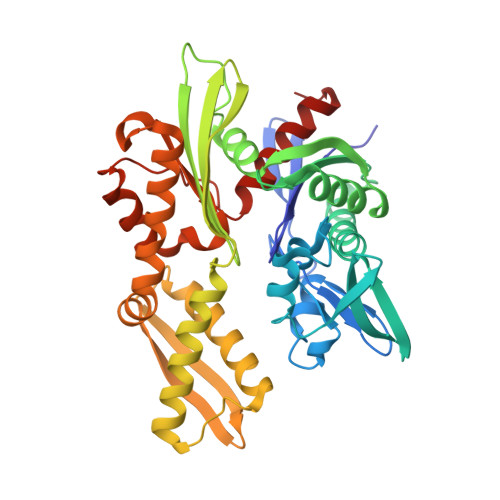
STRUCTURAL BASIS OF THE 70-KILODALTON HEAT SHOCK COGNATE PROTEIN ATP HYDROLYTIC ACTIVITY, II. STRUCTURE OF THE ACTIVE SITE WITH ADP OR ATP BOUND TO WILD TYPE AND MUTANT ATPASE FRAGMENT


Experimental Data Snapshot

  • Method: X-RAY DIFFRACTION
  • Resolution: 2.17 Å
  • R-Value Work: 
    0.185 (Depositor) 
  • R-Value Observed: 
    0.185 (Depositor) 

wwPDB Validation 3D Report Full Report

Validation slider image for 1NGF

This is version 1.3 of the entry. See complete history. 

Literature

Structural basis of the 70-kilodalton heat shock cognate protein ATP hydrolytic activity. II. Structure of the active site with ADP or ATP bound to wild type and mutant ATPase fragment.

Flaherty, K.M., Wilbanks, S.M., DeLuca-Flaherty, C., McKay, D.B.

(1994) J Biol Chem 269: 12899-12907

  • Primary Citation Related Structures: 
    1NGA, 1NGB, 1NGC, 1NGD, 1NGE, 1NGF, 1NGG, 1NGH, 1NGI, 1NGJ

  • PubMed Abstract: 

    The ATPase fragment of the bovine 70-kDa heat shock cognate protein is an attractive construct in which to study its mechanism of ATP hydrolysis. The three-dimensional structure suggests several residues that might participate in the ATPase reaction. Four acidic residues (Asp-10, Glu-175, Asp-199, and Asp-206) have been individually mutated to both the cognate amine (asparagine/glutamine) and to serine, and the effects of the mutations on the kinetics of the ATPase activity (Wilbanks, S. M., DeLuca-Flaherty, C., and McKay, D. B. (1994) J. Biol. Chem. 269, 12893-12898) and the structure of the mutant ATPase fragments have been determined, typically to approximately 2.4 A resolution. Additionally, the structures of the wild type protein complexed with MgADP and Pi, MgAMPPNP (5'-adenylyl-beta, gamma-imidodiphosphate) and CaAMPPNP have been refined to 2.1, 2.4, and 2.4 A, respectively. Combined, these structures provide models for the prehydrolysis, MgATP-bound state and the post-hydrolysis, MgADP-bound state of the ATPase fragment. These models suggest a pathway for the hydrolytic reaction in which 1) the gamma phosphate of bound ATP reorients to form a beta, gamma-bidentate phosphate complex with the Mg2+ ion, allowing 2) in-line nucleophilic attack on the gamma phosphate by a H2O molecule or OH- ion, with 3) subsequent release of inorganic phosphate.


  • Organizational Affiliation: 
    • Beckman Laboratories for Structural Biology, Department of Cell Biology, Stanford University School of Medicine, California 94305.

Macromolecule Content 

  • Total Structure Weight: 43.02 kDa 
  • Atom Count: 3,156 
  • Modeled Residue Count: 382 
  • Deposited Residue Count: 386 
  • Unique protein chains: 1

Macromolecules

Find similar proteins by:|  3D Structure
Entity ID: 1
MoleculeChains  Sequence LengthOrganismDetailsImage
HEAT-SHOCK COGNATE 70 kD PROTEIN386Bos taurusMutation(s): 0 
EC: 3.6.1.3 (PDB Primary Data), 3.6.4.10 (UniProt)
UniProt
Find proteins for P19120 (Bos taurus)
Explore P19120 
Go to UniProtKB:  P19120
Entity Groups
Sequence Clusters30% Identity50% Identity70% Identity90% Identity95% Identity100% Identity
UniProt GroupP19120
Sequence Annotations
Expand
Reference Sequence

Small Molecules

Ligands 1 Unique
IDChains Name / Formula / InChI Key2D Diagram3D Interactions
ATP

Query on ATP


Download:Ideal Coordinates CCD File
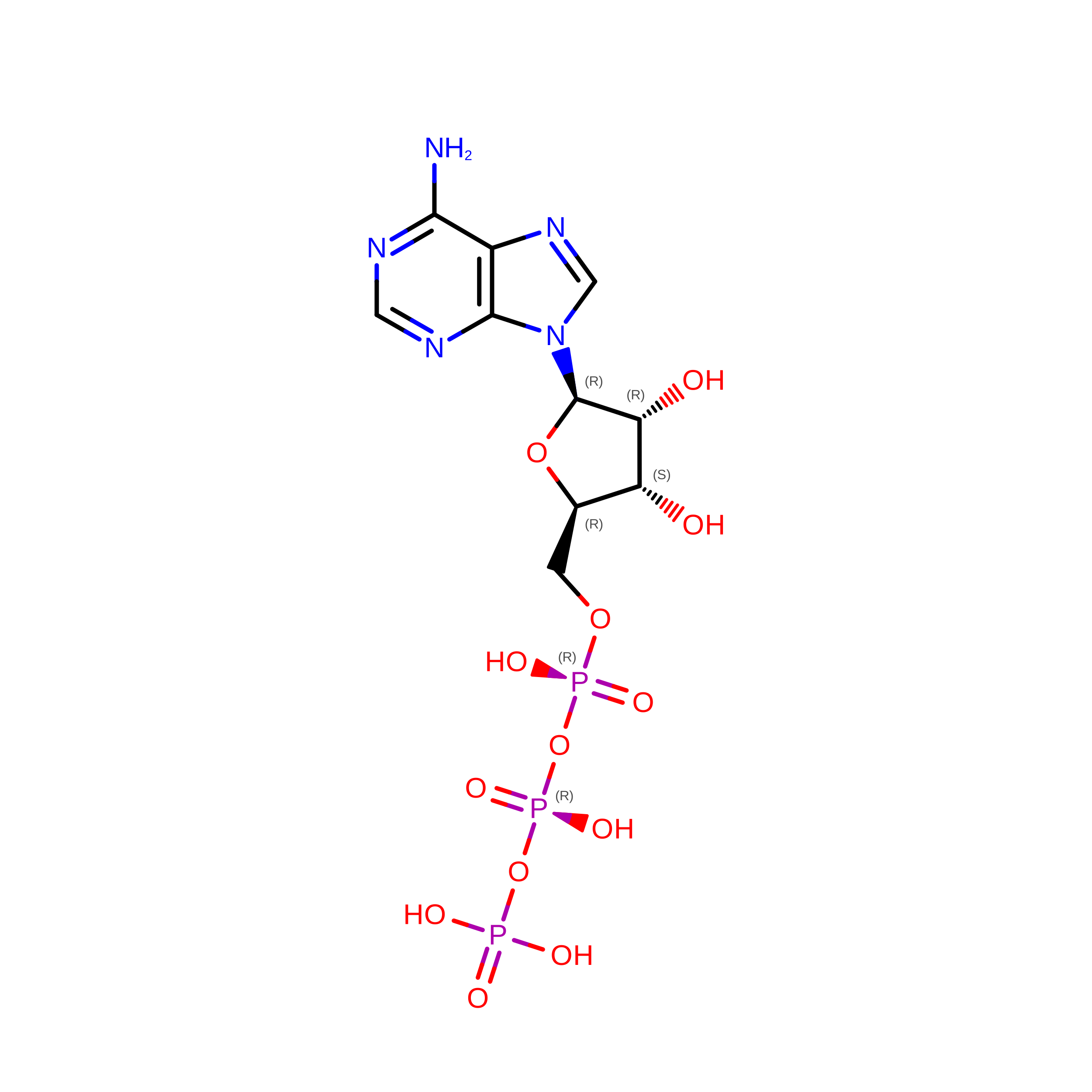
B [auth A]ADENOSINE-5'-TRIPHOSPHATE
C10 H16 N5 O13 P3
ZKHQWZAMYRWXGA-KQYNXXCUSA-N

Experimental Data & Validation

Experimental Data

  • Method: X-RAY DIFFRACTION
  • Resolution: 2.17 Å
  • R-Value Work:  0.185 (Depositor) 
  • R-Value Observed: 0.185 (Depositor) 
Space Group: P 21 21 21
Unit Cell:
Length ( Å )Angle ( ˚ )
a = 145.3α = 90
b = 65β = 90
c = 46.9γ = 90
Software Package:
Software NamePurpose
X-PLORmodel building
X-PLORrefinement
X-PLORphasing

Structure Validation

View Full Validation Report


Entry History 

Deposition Data

Revision History  (Full details and data files)

  • Version 1.0: 1994-08-31
    Type: Initial release
  • Version 1.1: 2008-03-24
    Changes: Version format compliance
  • Version 1.2: 2011-07-13
    Changes: Version format compliance
  • Version 1.3: 2024-02-14
    Changes: Data collection, Database references, Derived calculations, Other