1L8G | pdb_00001l8g

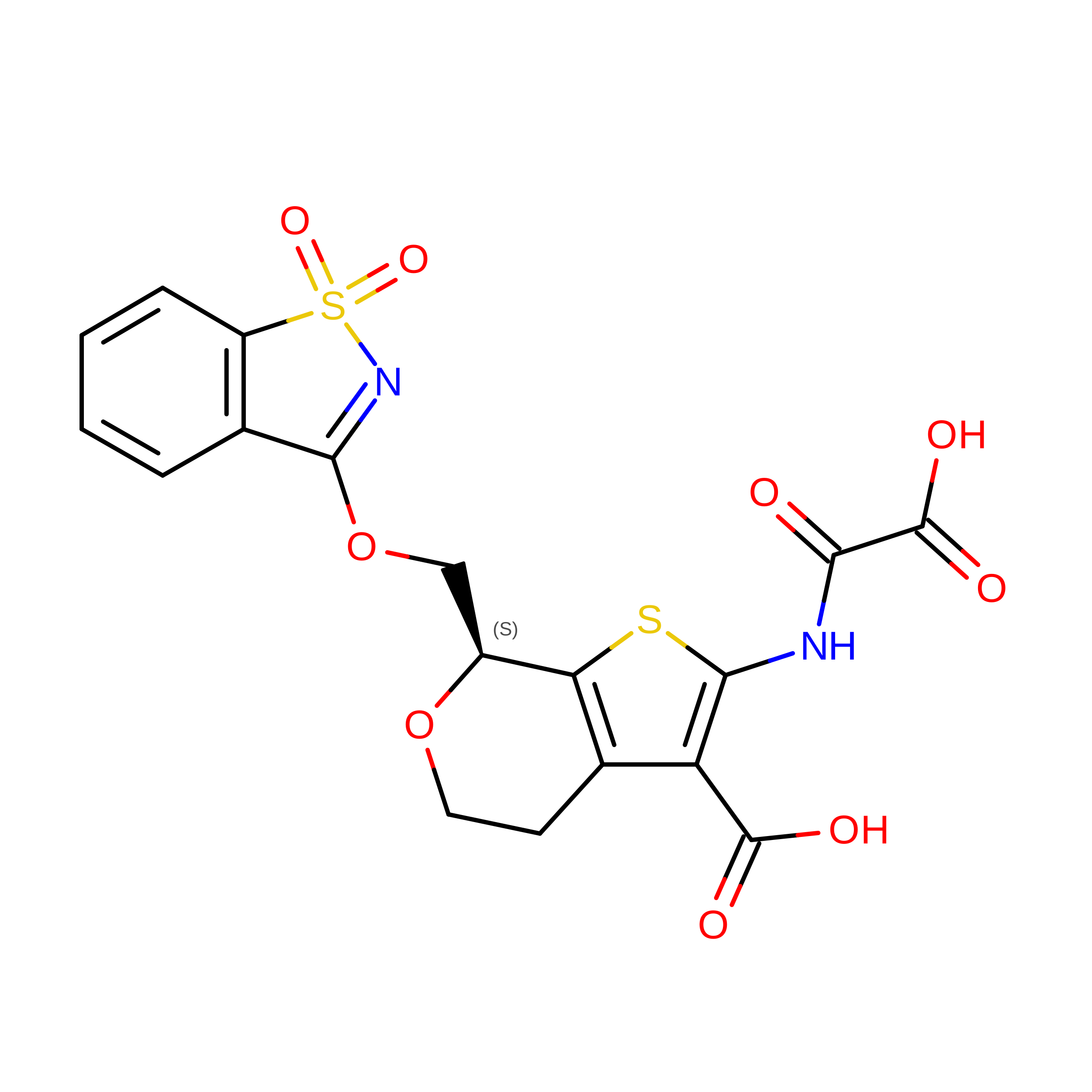
Crystal structure of PTP1B complexed with 7-(1,1-Dioxo-1H-benzo[d]isothiazol-3-yloxymethyl)-2-(oxalyl-amino)-4,7-dihydro-5H-thieno[2,3-c]pyran-3-carboxylic acid


Experimental Data Snapshot

  • Method: X-RAY DIFFRACTION
  • Resolution: 2.50 Å
  • R-Value Free: 
    0.270 (Depositor) 
  • R-Value Work: 
    0.189 (Depositor) 
  • R-Value Observed: 
    0.189 (Depositor) 

wwPDB Validation 3D Report Full Report

Validation slider image for 1L8G

This is version 1.3 of the entry. See complete history. 

Literature

Steric hindrance as a basis for structure-based design of selective inhibitors of protein-tyrosine phosphatases.

Iversen, L.F., Andersen, H.S., Moller, K.B., Olsen, O.H., Peters, G.H., Branner, S., Mortensen, S.B., Hansen, T.K., Lau, J., Ge, Y., Holsworth, D.D., Newman, M.J., Hundahl Moller, N.P.

(2001) Biochemistry 40: 14812-14820

  • DOI: https://doi.org/10.1021/bi011389l
  • Primary Citation Related Structures: 
    1L8G

  • PubMed Abstract: 

    Utilizing structure-based design, we have previously demonstrated that it is possible to obtain selective inhibitors of protein-tyrosine phosphatase 1B (PTP1B). A basic nitrogen was introduced into a general PTP inhibitor to form a salt bridge to Asp48 in PTP1B and simultaneously cause repulsion in PTPs containing an asparagine in the equivalent position [Iversen, L. F., et al. (2000) J. Biol. Chem. 275, 10300-10307]. Further, we have recently demonstrated that Gly259 in PTP1B forms the bottom of a gateway that allows easy access to the active site for a broad range of substrates, while bulky residues in the same position in other PTPs cause steric hindrance and reduced substrate recognition capacity [Peters, G. H., et al. (2000) J. Biol. Chem. 275, 18201-18209]. The current study was undertaken to investigate the feasibility of structure-based design, utilizing these differences in accessibility to the active site among various PTPs. We show that a general, low-molecular weight PTP inhibitor can be developed into a highly selective inhibitor for PTP1B and TC-PTP by introducing a substituent, which is designed to address the region around residues 258 and 259. Detailed enzyme kinetic analysis with a set of wild-type and mutant PTPs, X-ray protein crystallography, and molecular modeling studies confirmed that selectivity for PTP1B and TC-PTP was achieved due to steric hindrance imposed by bulky position 259 residues in other PTPs.


  • Organizational Affiliation: 
    • Protein Chemistry and Signal Transduction, Novo Nordisk, DK-2880 Bagsvaerd, Denmark. lfiv@novonordisk.com

Macromolecule Content 

  • Total Structure Weight: 37.83 kDa 
  • Atom Count: 2,593 
  • Modeled Residue Count: 297 
  • Deposited Residue Count: 321 
  • Unique protein chains: 1

Macromolecules

Find similar proteins by:|  3D Structure
Entity ID: 1
MoleculeChains  Sequence LengthOrganismDetailsImage
PROTEIN-TYROSINE PHOSPHATASE, NON-RECEPTOR TYPE 1321Homo sapiensMutation(s): 0 
EC: 3.1.3.48
UniProt & NIH Common Fund Data Resources
Find proteins for P18031 (Homo sapiens)
Explore P18031 
Go to UniProtKB:  P18031
PHAROS:  P18031
GTEx:  ENSG00000196396 
Entity Groups
Sequence Clusters30% Identity50% Identity70% Identity90% Identity95% Identity100% Identity
UniProt GroupP18031
Sequence Annotations
Expand
Reference Sequence

Small Molecules

Ligands 1 Unique
IDChains Name / Formula / InChI Key2D Diagram3D Interactions
DBD

Query on DBD


Download:Ideal Coordinates CCD File
B [auth A]7-(1,1-DIOXO-1H-BENZO[D]ISOTHIAZOL-3-YLOXYMETHYL)-2-(OXALYL-AMINO)-4,7-DIHYDRO-5H-THIENO[2,3-C]PYRAN-3-CARBOXYLIC ACID
C18 H14 N2 O9 S2
MDYIGSPVMWSFEZ-JTQLQIEISA-N

Experimental Data & Validation

Experimental Data

  • Method: X-RAY DIFFRACTION
  • Resolution: 2.50 Å
  • R-Value Free:  0.270 (Depositor) 
  • R-Value Work:  0.189 (Depositor) 
  • R-Value Observed: 0.189 (Depositor) 
Space Group: P 31 2 1
Unit Cell:
Length ( Å )Angle ( ˚ )
a = 88.258α = 90
b = 88.258β = 90
c = 103.617γ = 120
Software Package:
Software NamePurpose
AMoREphasing
X-PLORrefinement
DENZOdata reduction
CCP4data scaling

Structure Validation

View Full Validation Report


Entry History 

Revision History  (Full details and data files)

  • Version 1.0: 2002-05-08
    Type: Initial release
  • Version 1.1: 2008-04-28
    Changes: Version format compliance
  • Version 1.2: 2011-07-13
    Changes: Version format compliance
  • Version 1.3: 2024-02-14
    Changes: Data collection, Database references, Derived calculations