Download Mendeley
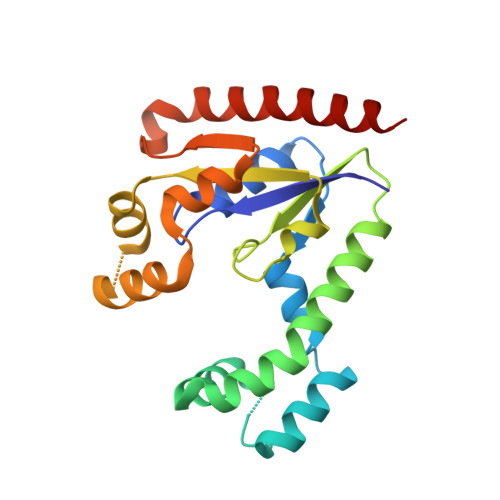
Crystal structure of dephospho-coenzyme A kinase from Haemophilus influenzae.
Obmolova, G., Teplyakov, A., Bonander, N., Eisenstein, E., Howard, A.J., Gilliland, G.L.(2001) J Struct Biol 136: 119-125
- PubMed: 11886213 Search on PubMed
- DOI: https://doi.org/10.1006/jsbi.2001.4428
- Primary Citation Related Structures:
1JJV - PubMed Abstract:
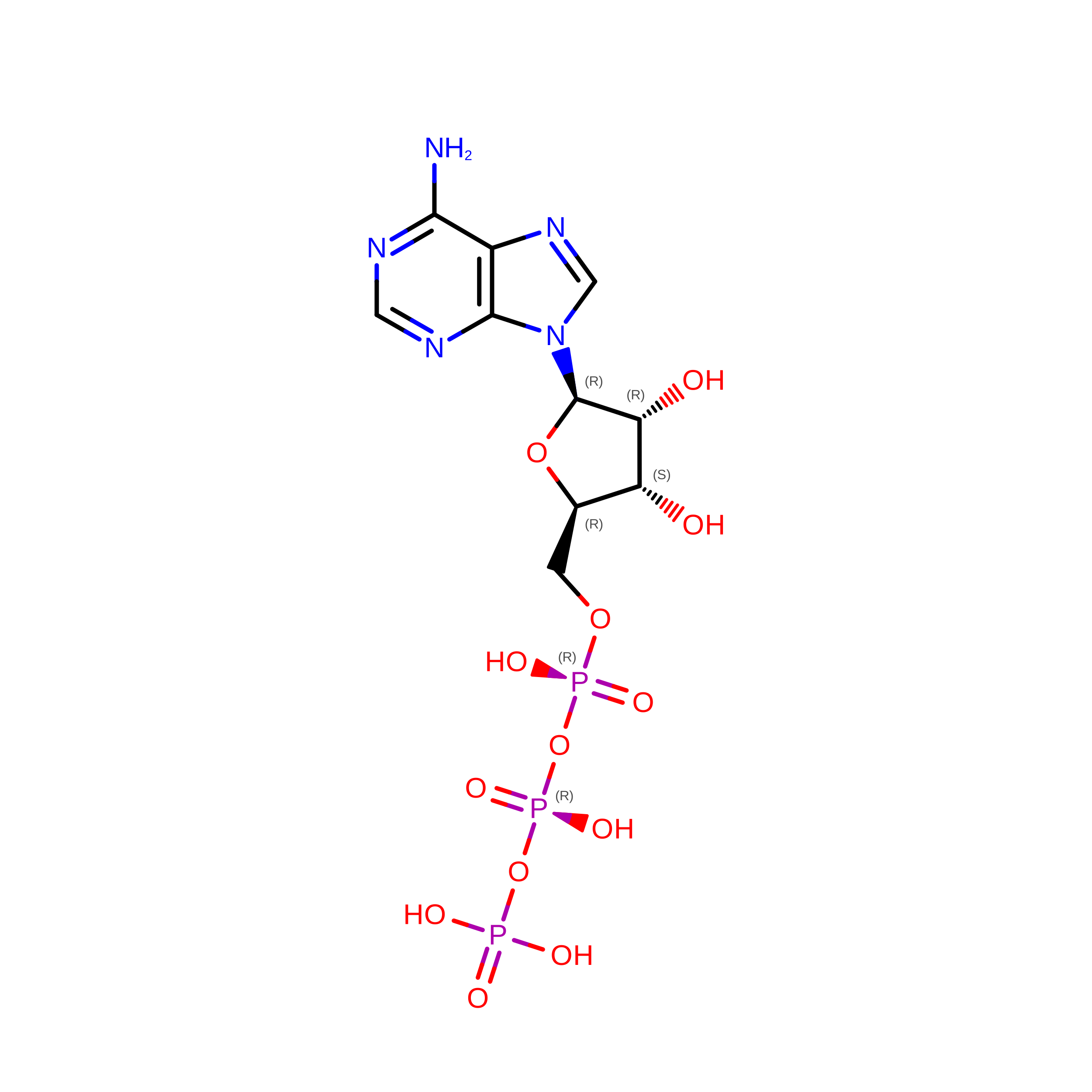
Dephospho-coenzyme A kinase catalyzes the final step in CoA biosynthesis, the phosphorylation of the 3'-hydroxyl group of ribose using ATP as a phosphate donor. The protein from Haemophilus influenzae was cloned and expressed, and its crystal structure was determined at 2.0-A resolution in complex with ATP. The protein molecule consists of three domains: the canonical nucleotide-binding domain with a five-stranded parallel beta-sheet, the substrate-binding alpha-helical domain, and the lid domain formed by a pair of alpha-helices. The overall topology of the protein resembles the structures of nucleotide kinases. ATP binds in the P-loop in a manner observed in other kinases. The CoA-binding site is located at the interface of all three domains. The double-pocket structure of the substrate-binding site is unusual for nucleotide kinases. Amino acid residues implicated in substrate binding and catalysis have been identified. The structure analysis suggests large domain movements during the catalytic cycle.
- Center for Advanced Research in Biotechnology of the University of Maryland Biotechnology Institute, National Institute of Standards and Technology, 9600 Gudelsky Drive, Rockville, Maryland 20850, USA.
Organizational Affiliation: