Download Mendeley
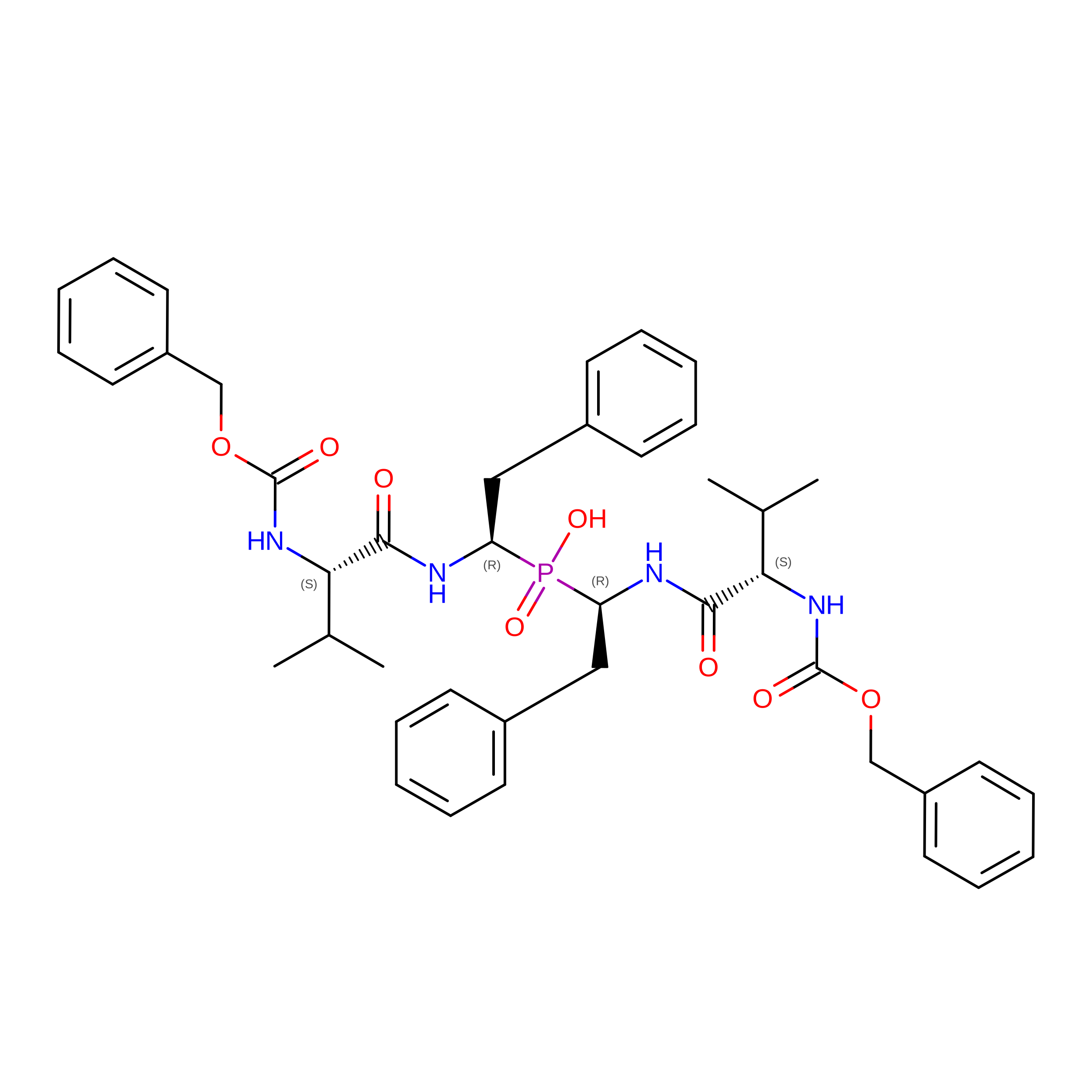
Inhibition of human immunodeficiency virus-1 protease by a C2-symmetric phosphinate. Synthesis and crystallographic analysis.
Abdel-Meguid, S.S., Zhao, B., Murthy, K.H., Winborne, E., Choi, J.K., DesJarlais, R.L., Minnich, M.D., Culp, J.S., Debouck, C., Tomaszek Jr., T.A., Meek, T.D., Dreyer, G.B.(1993) Biochemistry 32: 7972-7980
- PubMed: 8347601 Search on PubMed
- DOI: https://doi.org/10.1021/bi00082a019
- Primary Citation Related Structures:
1HOS - PubMed Abstract:
The human immunodeficiency virus type 1 (HIV-1) protease is a potential target of acquired immune deficiency syndrome (AIDS) therapy. A highly potent, perfectly symmetrical phosphinate inhibitor of this enzyme, SB204144, has been synthesized. It is a competitive inhibitor of HIV-1 protease, with an apparent inhibition constant of 2.8 nM at pH 6.0. The three-dimensional structure of SB204144 bound to the enzyme has been determined at 2.3-A resolution by X-ray diffraction techniques and refined to a crystallographic discrepancy factor, R (= sigma parallel F(o) magnitude to - Fc parallel/sigma magnitude of F(o)), of 0.178. The inhibitor is held in the enzyme active site by a set of hydrophobic and hydrophilic interactions, including an interaction between Arg8 and the center of the terminal benzene rings of the inhibitor. The phosphinate establishes a novel interaction with the two catalytic aspartates; each oxygen of the central phosphinic acid moiety interacts with a single oxygen of one aspartic acid, establishing a very short (2.2-2.4 A) oxygen-oxygen contact. As with the structures of penicillopepsin bound to phosphinate and phosphonate inhibitors [Fraser, M. E., Strynadka, N. C., Bartlett, P. A., Hanson, J. E., & James, M. N. (1992) Biochemistry 31, 5201-14], we interpret this short distance and the stereochemical environment of each pair of oxygens in terms of a hydrogen bond that has a symmetric single-well potential energy curve with the proton located midway between the two atoms.(ABSTRACT TRUNCATED AT 250 WORDS)
- Department of Macromolecular Sciences, SmithKline Beecham, King of Prussia, Pennsylvania 19406.
Organizational Affiliation: