1GL3 | pdb_00001gl3

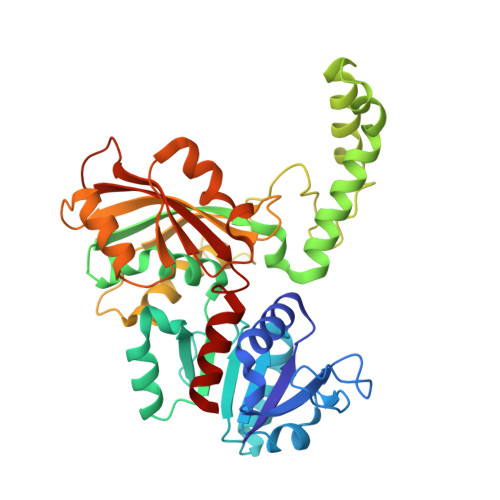
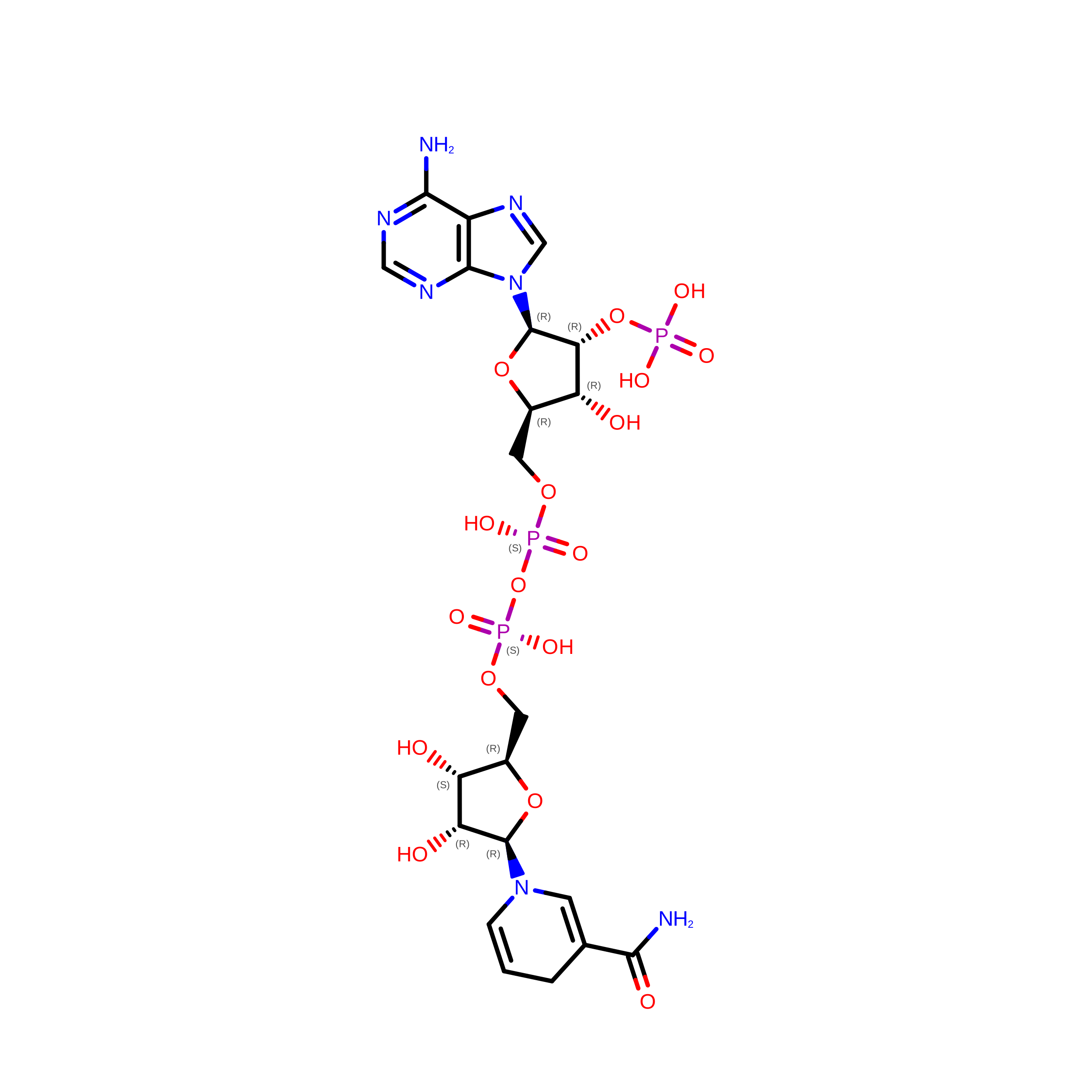
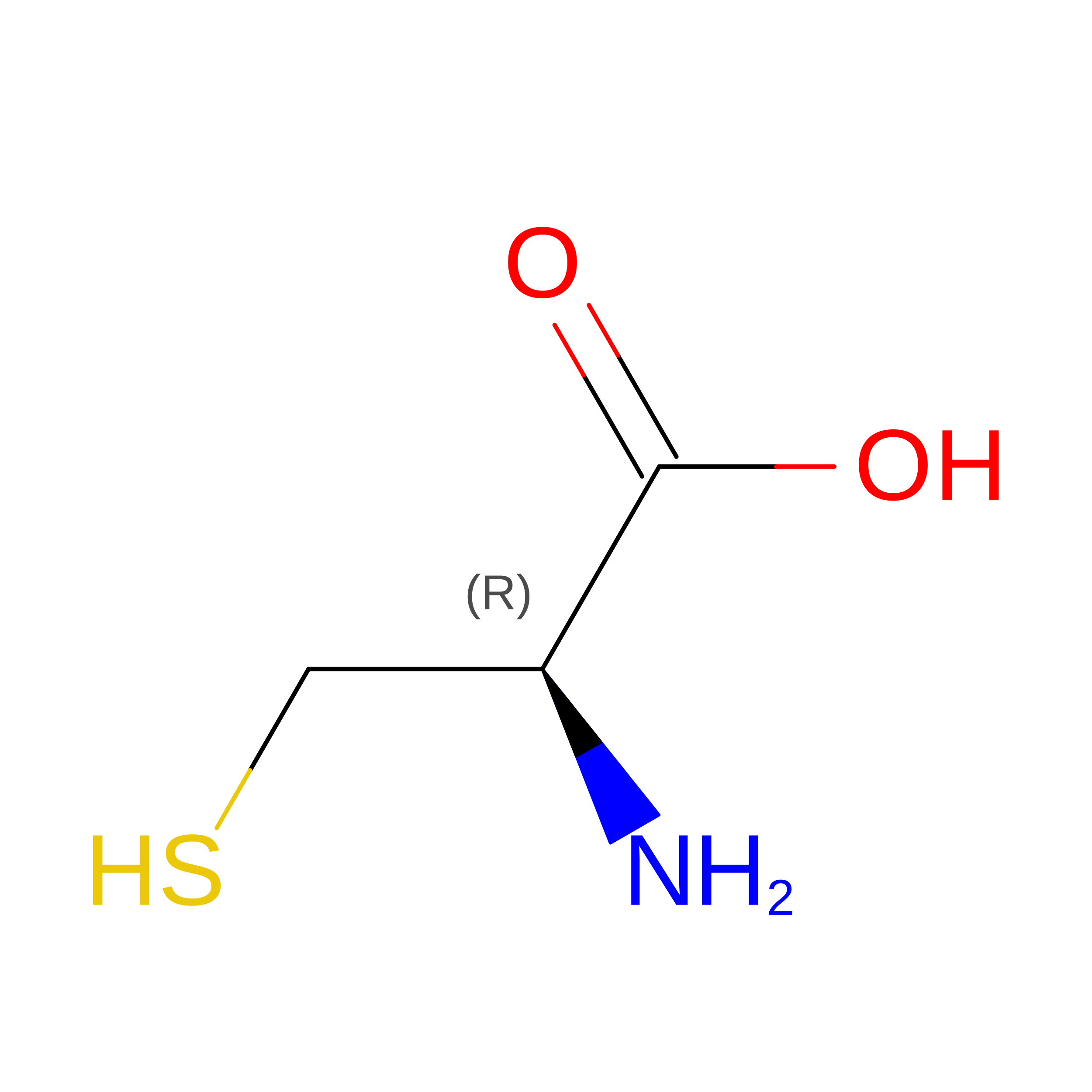
ASPARTATE BETA-SEMIALDEHYDE DEHYDROGENASE IN COMPLEX WITH NADP AND SUBSTRATE ANALOGUE S-METHYL CYSTEINE SULFOXIDE


Experimental Data Snapshot

  • Method: X-RAY DIFFRACTION
  • Resolution: 2.60 Å
  • R-Value Free: 
    0.262 (Depositor), 0.261 (DCC) 
  • R-Value Work: 
    0.200 (Depositor), 0.201 (DCC) 
  • R-Value Observed: 
    0.200 (Depositor) 

Starting Model: experimental
View more details

wwPDB Validation 3D Report Full Report

Validation slider image for 1GL3

Ligand Structure Quality Assessment 


This is version 1.6 of the entry. See complete history

Literature

Active Site Analysis of the Potential Antimicrobial Target Aspartate Semialdehyde Dehydrogenase.

Hadfield, A.T.Shammas, C.Kryger, G.Ringe, D.Petsko, G.A.Ouyang, J.Viola, R.E.

(2001) Biochemistry 40: 14475

  • DOI: https://doi.org/10.1021/bi015713o
  • Primary Citation Related Structures: 
    1GL3

  • PubMed Abstract: 

    Aspartate-beta-semialdehyde dehydrogenase (ASADH) lies at the first branch point in the biosynthetic pathway through which bacteria, fungi, and the higher plants synthesize amino acids, including lysine and methionine and the cell wall component diaminopimelate from aspartate. Blocks in this biosynthetic pathway, which is absent in mammals, are lethal, and inhibitors of ASADH may therefore serve as useful antibacterial, fungicidal, or herbicidal agents. We have determined the structure of ASADH from Escherichia coli by crystallography in the presence of its coenzyme and a substrate analogue that acts as a covalent inhibitor. This structure is comparable to that of the covalent intermediate that forms during the reaction catalyzed by ASADH. The key catalytic residues are confirmed as cysteine 135, which is covalently linked to the intermediate during the reaction, and histidine 274, which acts as an acid/base catalyst. The substrate and coenzyme binding residues are also identified, and these active site residues are conserved throughout all of the ASADH sequences. Comparison of the previously determined apo-enzyme structure [Hadfield et al. J. Mol. Biol. (1999) 289, 991-1002] and the complex presented here reveals a conformational change that occurs on binding of NADP that creates a binding site for the amino acid substrate. These results provide a structural explanation for the preferred order of substrate binding that is observed kinetically.


  • Organizational Affiliation
    • Department of Biochemistry, School of Medical Sciences, University of Bristol, University Walk, Bristol BS8 1TD, England. a.t.hadfield@bris.ac.uk

Macromolecule Content 

  • Total Structure Weight: 81.73 kDa 
  • Atom Count: 5,894 
  • Modeled Residue Count: 734 
  • Deposited Residue Count: 734 
  • Unique protein chains: 1

Macromolecules

Find similar proteins by:|  3D Structure
Entity ID: 1
MoleculeChains  Sequence LengthOrganismDetailsImage
ASPARTATE-SEMIALDEHYDE DEHYDROGENASE
A, B
367Escherichia coliMutation(s): 0 
EC: 1.2.1.11
UniProt
Find proteins for P0A9Q9 (Escherichia coli (strain K12))
Explore P0A9Q9 
Go to UniProtKB:  P0A9Q9
Entity Groups
Sequence Clusters30% Identity50% Identity70% Identity90% Identity95% Identity100% Identity
UniProt GroupP0A9Q9
Sequence Annotations
Expand
Reference Sequence

Experimental Data & Validation

Experimental Data

  • Method: X-RAY DIFFRACTION
  • Resolution: 2.60 Å
  • R-Value Free:  0.262 (Depositor), 0.261 (DCC) 
  • R-Value Work:  0.200 (Depositor), 0.201 (DCC) 
  • R-Value Observed: 0.200 (Depositor) 
Space Group: P 64
Unit Cell:
Length ( Å )Angle ( ˚ )
a = 121α = 90
b = 121β = 90
c = 94γ = 120
Software Package:
Software NamePurpose
X-PLORrefinement
XDSdata reduction
CCP4data scaling
CCP4phasing

Structure Validation

View Full Validation Report


Ligand Structure Quality Assessment 


Entry History 

Deposition Data

Revision History  (Full details and data files)

  • Version 1.0: 2001-11-01
    Type: Initial release
  • Version 1.1: 2011-05-08
    Changes: Version format compliance
  • Version 1.2: 2011-07-13
    Changes: Version format compliance
  • Version 1.3: 2019-04-10
    Changes: Data collection, Derived calculations, Other, Source and taxonomy
  • Version 1.4: 2023-11-08
    Changes: Data collection, Database references, Derived calculations, Other
  • Version 1.5: 2023-12-13
    Changes: Refinement description
  • Version 1.6: 2024-11-06
    Changes: Structure summary