1GED | pdb_00001ged

A positive charge route for the access of nadh to heme formed in the distal heme pocket of cytochrome p450nor


Experimental Data Snapshot

  • Method: X-RAY DIFFRACTION
  • Resolution: 2.00 Å
  • R-Value Free: 
    0.279 (Depositor) 
  • R-Value Work: 
    0.214 (Depositor) 

Starting Model: experimental
View more details

wwPDB Validation 3D Report Full Report

Validation slider image for 1GED

This is version 1.3 of the entry. See complete history

Literature

A positively charged cluster formed in the heme-distal pocket of cytochrome P450nor is essential for interaction with NADH

Kudo, T.Takaya, N.Park, S.-Y.Shiro, Y.Shoun, H.

(2001) J Biological Chem 276: 5020-5026

  • DOI: https://doi.org/10.1074/jbc.M007244200
  • Primary Citation Related Structures: 
    1GED

  • PubMed Abstract: 

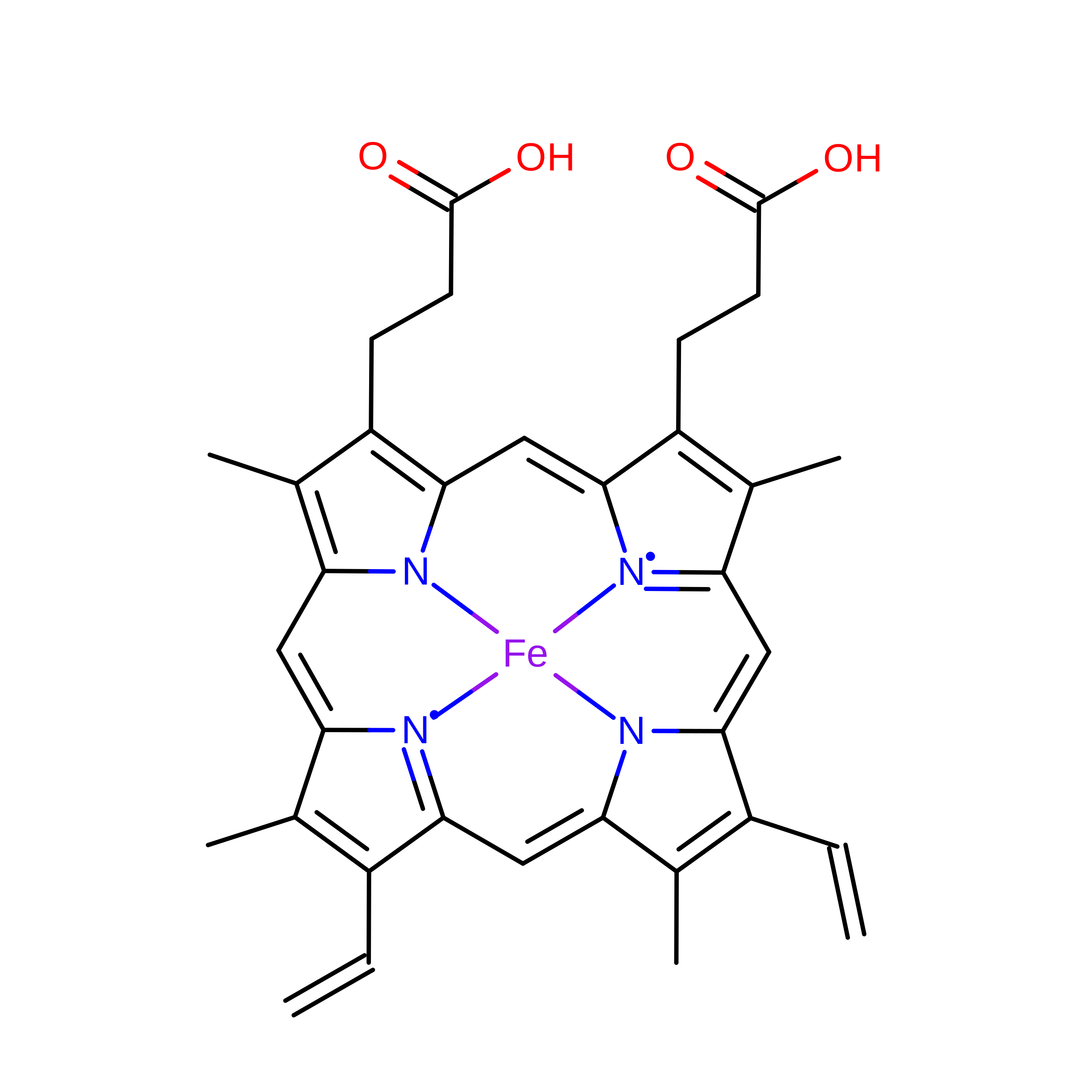
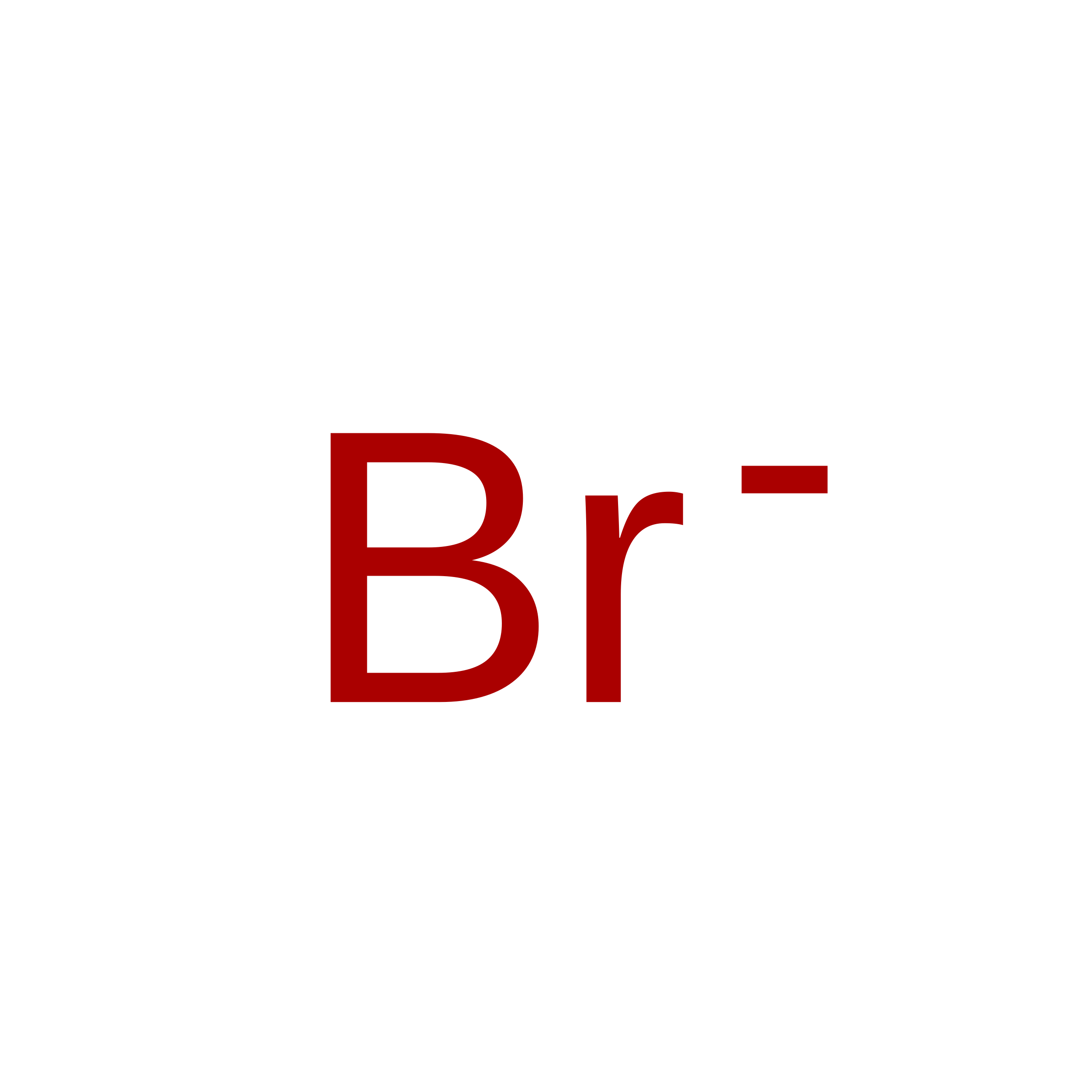
    Arg and Lys residues are concentrated on the distal side of cytochrome P450nor (P450nor) to form a positively charged cluster facing from the outside to the inside of the distal heme pocket. We constructed mutant proteins in which the Arg and Lys residues were replaced with Glu, Gln, or Ala. The results showed that this cluster plays crucial roles in NADH interaction. We also showed that some anions such as bromide (Br(-)) perturbed the heme environment along with the reduction step in P450nor-catalyzed reactions, which was similar to the effects caused by the mutations. We determined by x-ray crystallography that a Br(-), termed an anion hole, occupies a key region neighboring heme, which is the terminus of the positively charged cluster and the terminus of the hydrogen bond network that acts as a proton delivery system. A comparison of the predicted mechanisms between the perturbations caused by Br(-) and the mutations suggested that Arg(174) and Arg(64) play a crucial role in binding NADH to the protein. These results indicated that the positively charged cluster is the unique structure of P450nor that responds to direct interaction with NADH.


  • Organizational Affiliation
    • Institute of Applied Biochemistry, University of Tsukuba, Tsukuba, Ibaraki 305-8572, Japan.

Macromolecule Content 

  • Total Structure Weight: 45.2 kDa 
  • Atom Count: 3,250 
  • Modeled Residue Count: 399 
  • Deposited Residue Count: 403 
  • Unique protein chains: 1

Macromolecules

Find similar proteins by:|  3D Structure
Entity ID: 1
MoleculeChains  Sequence LengthOrganismDetailsImage
CYTOCHROME P450 55A1403Fusarium oxysporumMutation(s): 0 
EC: 1.14 (PDB Primary Data), 1.7.1.14 (UniProt)
UniProt
Find proteins for P23295 (Fusarium oxysporum)
Explore P23295 
Go to UniProtKB:  P23295
Entity Groups
Sequence Clusters30% Identity50% Identity70% Identity90% Identity95% Identity100% Identity
UniProt GroupP23295
Sequence Annotations
Expand
Reference Sequence

Small Molecules

Experimental Data & Validation

Experimental Data

  • Method: X-RAY DIFFRACTION
  • Resolution: 2.00 Å
  • R-Value Free:  0.279 (Depositor) 
  • R-Value Work:  0.214 (Depositor) 
Space Group: P 21 21 21
Unit Cell:
Length ( Å )Angle ( ˚ )
a = 54.32α = 90
b = 78.05β = 90
c = 86.6γ = 90
Software Package:
Software NamePurpose
DENZOdata reduction
SCALEPACKdata scaling
X-PLORmodel building
X-PLORrefinement
X-PLORphasing

Structure Validation

View Full Validation Report


Entry History 

Deposition Data

Revision History  (Full details and data files)

  • Version 1.0: 2000-11-22
    Type: Initial release
  • Version 1.1: 2008-04-27
    Changes: Version format compliance
  • Version 1.2: 2011-07-13
    Changes: Version format compliance
  • Version 1.3: 2023-10-25
    Changes: Data collection, Database references, Derived calculations, Refinement description