Download Mendeley
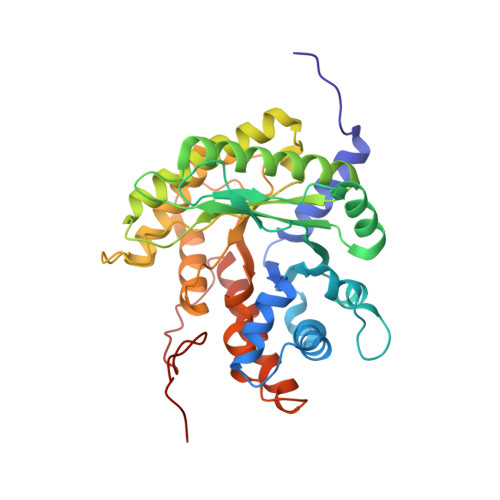
A conserved glutamate residue exhibits multifunctional catalytic roles in D-fructose-1,6-bisphosphate aldolases.
MAURADY, A., ZDANOV, A., De Moissac, D., Beaudry, D., SYGUSCH, J.(2002) J Biol Chem 277: 9474-9483
- PubMed: 11779856 Search on PubMed
- DOI: https://doi.org/10.1074/jbc.M107600200
- Primary Citation Related Structures:
1EWD, 1EWE, 1EX5, 3B8D - PubMed Abstract:
The aldolase catalytic cycle consists of a number of proton transfers that interconvert covalent enzyme intermediates. Glu-187 is a conserved amino acid that is located in the mammalian fructose-1,6-bisphosphate aldolase active site. Its central location, within hydrogen bonding distance of three other conserved active site residues: Lys-146, Glu-189, and Schiff base-forming Lys-229, makes it an ideal candidate for mediating proton transfers. Point mutations, Glu-187--> Gln, Ala, which would inhibit proton transfers significantly, compromise activity. Trapping of enzymatic intermediates in Glu-187 mutants defines a proton transfer role for Glu-187 in substrate cleavage and Schiff base formation. Structural data show that loss of Glu-187 negative charge results in hydrogen bond formation between Lys-146 and Lys-229 consistent with a basic pK(a) for Lys-229 in native enzyme and supporting nucleophilic activation of Lys-229 by Glu-187 during Schiff base formation. The crystal structures also substantiate Glu-187 and Glu-189 as present in ionized form in native enzyme, compatible with their role of catalyzing proton exchange with solvent as indicated from solvent isotope effects. The proton exchange mechanism ensures Glu-187 basicity throughout the catalytic cycle requisite for mediating proton transfer and electrostatic stabilization of ketamine intermediates. Glutamate general base catalysis is a recurrent evolutionary feature of Schiff base0forming aldolases.
- Department of Biochemistry, University of Montreal, CP 6128, Station Centre Ville, Montréal, Québec H3C 3J7, Canada.
Organizational Affiliation: