1EK1 | pdb_00001ek1

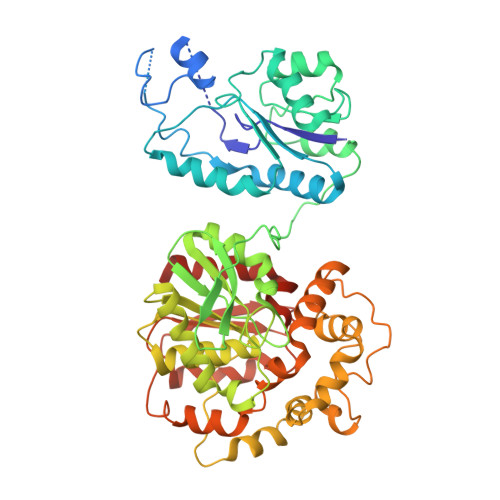
CRYSTAL STRUCTURE OF MURINE SOLUBLE EPOXIDE HYDROLASE COMPLEXED WITH CIU INHIBITOR


Experimental Data Snapshot

  • Method: X-RAY DIFFRACTION
  • Resolution: 3.10 Å
  • R-Value Free: 
    0.305 (Depositor) 
  • R-Value Work: 
    0.194 (Depositor) 

wwPDB Validation 3D Report Full Report

Validation slider image for 1EK1

This is version 1.3 of the entry. See complete history

Literature

Binding of alkylurea inhibitors to epoxide hydrolase implicates active site tyrosines in substrate activation.

Argiriadi, M.A.Morisseau, C.Goodrow, M.H.Dowdy, D.L.Hammock, B.D.Christianson, D.W.

(2000) J Biological Chem 275: 15265-15270

  • DOI: https://doi.org/10.1074/jbc.M000278200
  • Primary Citation Related Structures: 
    1EK1, 1EK2

  • PubMed Abstract: 

    The structures of two alkylurea inhibitors complexed with murine soluble epoxide hydrolase have been determined by x-ray crystallographic methods. The alkyl substituents of each inhibitor make extensive hydrophobic contacts in the soluble epoxide hydrolase active site, and each urea carbonyl oxygen accepts hydrogen bonds from the phenolic hydroxyl groups of Tyr(381) and Tyr(465). These hydrogen bond interactions suggest that Tyr(381) and/or Tyr(465) are general acid catalysts that facilitate epoxide ring opening in the first step of the hydrolysis reaction; Tyr(465) is highly conserved among all epoxide hydrolases, and Tyr(381) is conserved among the soluble epoxide hydrolases. In one enzyme-inhibitor complex, the urea carbonyl oxygen additionally interacts with Gln(382). If a comparable interaction occurs in catalysis, then Gln(382) may provide electrostatic stabilization of partial negative charge on the epoxide oxygen. The carboxylate side chain of Asp(333) accepts a hydrogen bond from one of the urea NH groups in each enzyme-inhibitor complex. Because Asp(333) is the catalytic nucleophile, its interaction with the partial positive charge on the urea NH group mimics its approach toward the partial positive charge on the electrophilic carbon of an epoxide substrate. Accordingly, alkylurea inhibitors mimic features encountered in the reaction coordinate of epoxide ring opening, and a structure-based mechanism is proposed for leukotoxin epoxide hydrolysis.


  • Organizational Affiliation
    • Roy and Diana Vagelos Laboratories, Department of Chemistry, University of Pennsylvania, Philadelphia, Pennsylvania 19104-6323, USA.

Macromolecule Content 

  • Total Structure Weight: 125.85 kDa 
  • Atom Count: 8,255 
  • Modeled Residue Count: 1,031 
  • Deposited Residue Count: 1,108 
  • Unique protein chains: 1

Macromolecules

Find similar proteins by:|  3D Structure
Entity ID: 1
MoleculeChains  Sequence LengthOrganismDetailsImage
EPOXIDE HYDROLASE
A, B
554Mus musculusMutation(s): 0 
EC: 3.3.2.3 (PDB Primary Data), 3.1.3.76 (UniProt), 3.3.2.10 (UniProt)
UniProt
Find proteins for P34914 (Mus musculus)
Explore P34914 
Go to UniProtKB:  P34914
Entity Groups
Sequence Clusters30% Identity50% Identity70% Identity90% Identity95% Identity100% Identity
UniProt GroupP34914
Sequence Annotations
Expand
Reference Sequence

Small Molecules

Ligands 1 Unique
IDChains Name / Formula / InChI Key2D Diagram3D Interactions
CIU

Query on CIU


Download:Ideal Coordinates CCD File
C [auth A],
D [auth B]
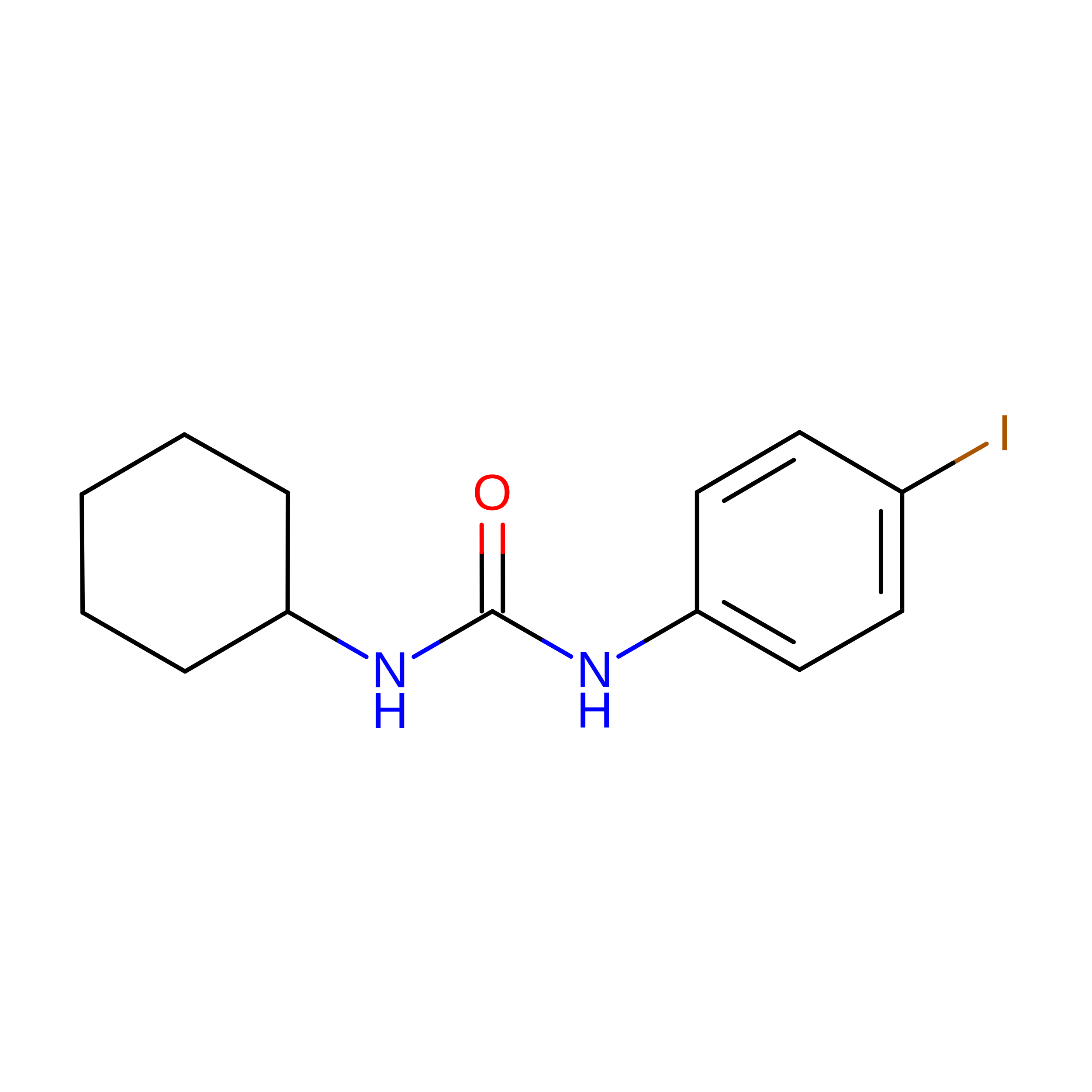
N-CYCLOHEXYL-N'-(4-IODOPHENYL)UREA
C13 H17 I N2 O
AQTBUVAFYDVTFD-UHFFFAOYSA-N

Experimental Data & Validation

Experimental Data

  • Method: X-RAY DIFFRACTION
  • Resolution: 3.10 Å
  • R-Value Free:  0.305 (Depositor) 
  • R-Value Work:  0.194 (Depositor) 
Space Group: P 21 21 2
Unit Cell:
Length ( Å )Angle ( ˚ )
a = 151.9α = 90
b = 143β = 90
c = 60γ = 90
Software Package:
Software NamePurpose
X-PLORmodel building
X-PLORrefinement
DENZOdata reduction
SCALEPACKdata scaling
X-PLORphasing

Structure Validation

View Full Validation Report


Entry History 

Deposition Data

Revision History  (Full details and data files)

  • Version 1.0: 2000-05-31
    Type: Initial release
  • Version 1.1: 2008-04-27
    Changes: Version format compliance
  • Version 1.2: 2011-07-13
    Changes: Version format compliance
  • Version 1.3: 2024-02-07
    Changes: Data collection, Database references, Derived calculations