1CIW | pdb_00001ciw

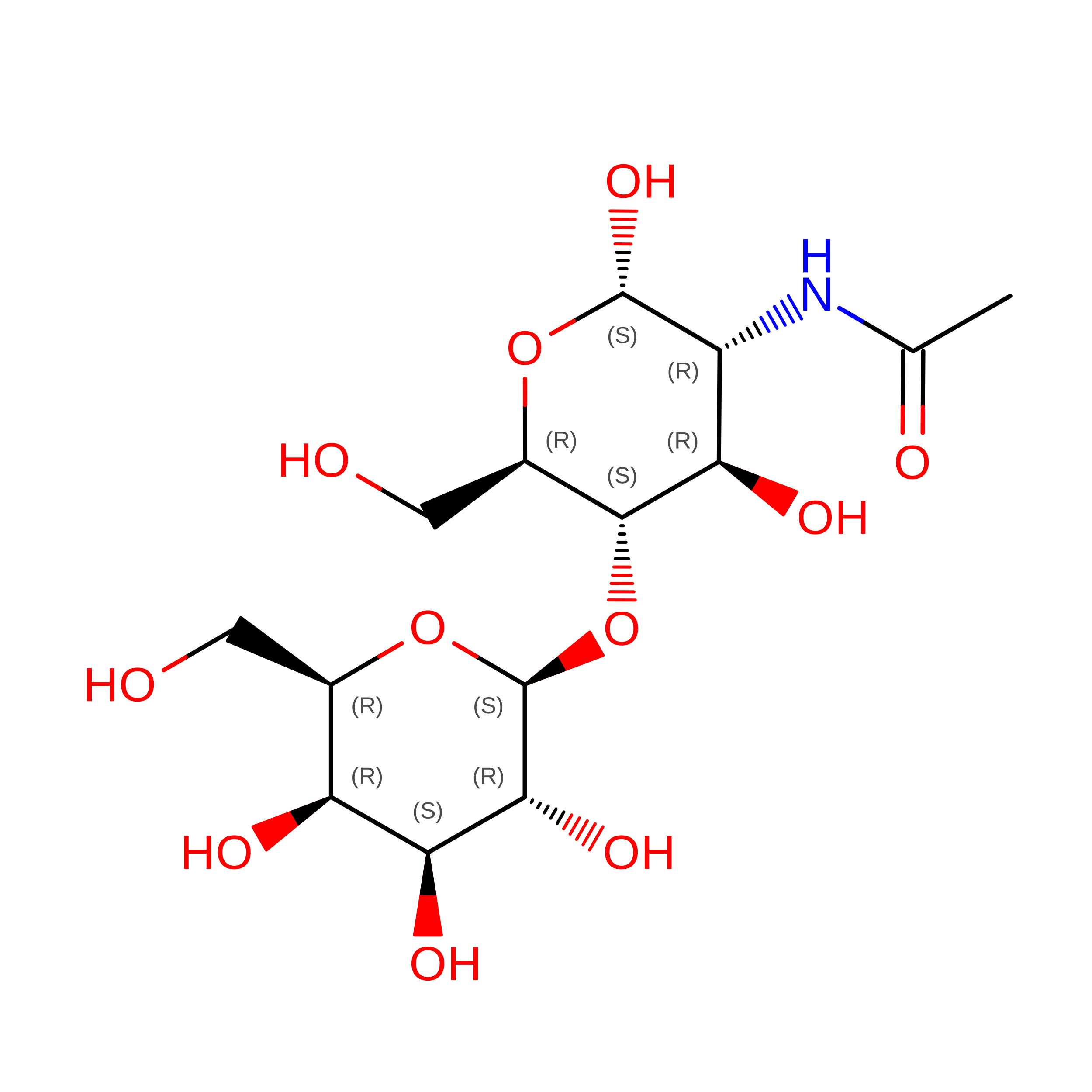
PEANUT LECTIN COMPLEXED WITH N-ACETYLLACTOSAMINE


Experimental Data Snapshot

  • Method: X-RAY DIFFRACTION
  • Resolution: 2.70 Å
  • R-Value Free: 
    0.244 (Depositor), 0.248 (DCC) 
  • R-Value Work: 
    0.194 (Depositor), 0.203 (DCC) 

Starting Model: experimental
View more details

wwPDB Validation 3D Report Full Report

Validation slider image for 1CIW

This is version 2.2 of the entry. See complete history

Literature

Structures of the complexes of peanut lectin with methyl-beta-galactose and N-acetyllactosamine and a comparative study of carbohydrate binding in Gal/GalNAc-specific legume lectins.

Ravishankar, R.Suguna, K.Surolia, A.Vijayan, M.

(1999) Acta Crystallogr D Biol Crystallogr 55: 1375-1382

  • DOI: https://doi.org/10.1107/s0907444999006587
  • Primary Citation Related Structures: 
    1CIW, 1QF3

  • PubMed Abstract: 

    The crystal structures of complexes of peanut lectin with methyl-beta-galactose and N-acetyllactosamine have been determined at 2.8 and 2.7 A, respectively. These, and the complexes involving lactose and the T-antigenic disaccharide reported previously, permit a detailed characterization of peanut-lectin-carbohydrate association and the role of water molecules therein. The water molecules in the combining site are substantially conserved in the four complexes. The role of interacting sugar hydroxyl groups, when absent, are often mimicked by ordered water molecules not only at the primary combining site, but also at the site of the second sugar ring. The similarity of peanut-lectin-sugar interactions with those in other galactose/N-acetylgalactosamine-specific lectins also extend to a substantial degree to water bridges. The comparative study provides a structural explanation for the exclusive specificity of peanut lectin for galactose at the monosaccharide level, compared with that of the other lectins for galactose as well as N-acetylgalactosamine. The complexes also provide a qualitative structural rationale for differences in the strengths of binding of peanut lectin to different sugars.


  • Organizational Affiliation
    • Molecular Biophysics Unit, Indian Institute of Science, Bangalore 560 012, India.

Macromolecule Content 

  • Total Structure Weight: 102.75 kDa 
  • Atom Count: 7,511 
  • Modeled Residue Count: 928 
  • Deposited Residue Count: 944 
  • Unique protein chains: 1

Macromolecules

Find similar proteins by:|  3D Structure
Entity ID: 1
MoleculeChains  Sequence LengthOrganismDetailsImage
PROTEIN (PEANUT LECTIN)
A, B, C, D
236Arachis hypogaeaMutation(s): 0 
UniProt
Find proteins for P02872 (Arachis hypogaea)
Explore P02872 
Go to UniProtKB:  P02872
Entity Groups
Sequence Clusters30% Identity50% Identity70% Identity90% Identity95% Identity100% Identity
UniProt GroupP02872
Sequence Annotations
Expand
Reference Sequence

Oligosaccharides

Help  
Entity ID: 2
MoleculeChains Length2D Diagram GlycosylationD Interactions
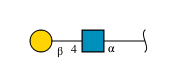
beta-D-galactopyranose-(1-4)-2-acetamido-2-deoxy-alpha-D-glucopyranose
E, F, G, H
2N/A
Glycosylation Resources
GlyTouCan: G79333MY
GlyCosmos: G79333MY
GlyGen: G79333MY

Small Molecules

Ligands 2 Unique
IDChains Name / Formula / InChI Key2D Diagram3D Interactions
MN

Query on MN


Download:Ideal Coordinates CCD File
J [auth A],
L [auth B],
N [auth C],
P [auth D]
MANGANESE (II) ION
Mn
WAEMQWOKJMHJLA-UHFFFAOYSA-N
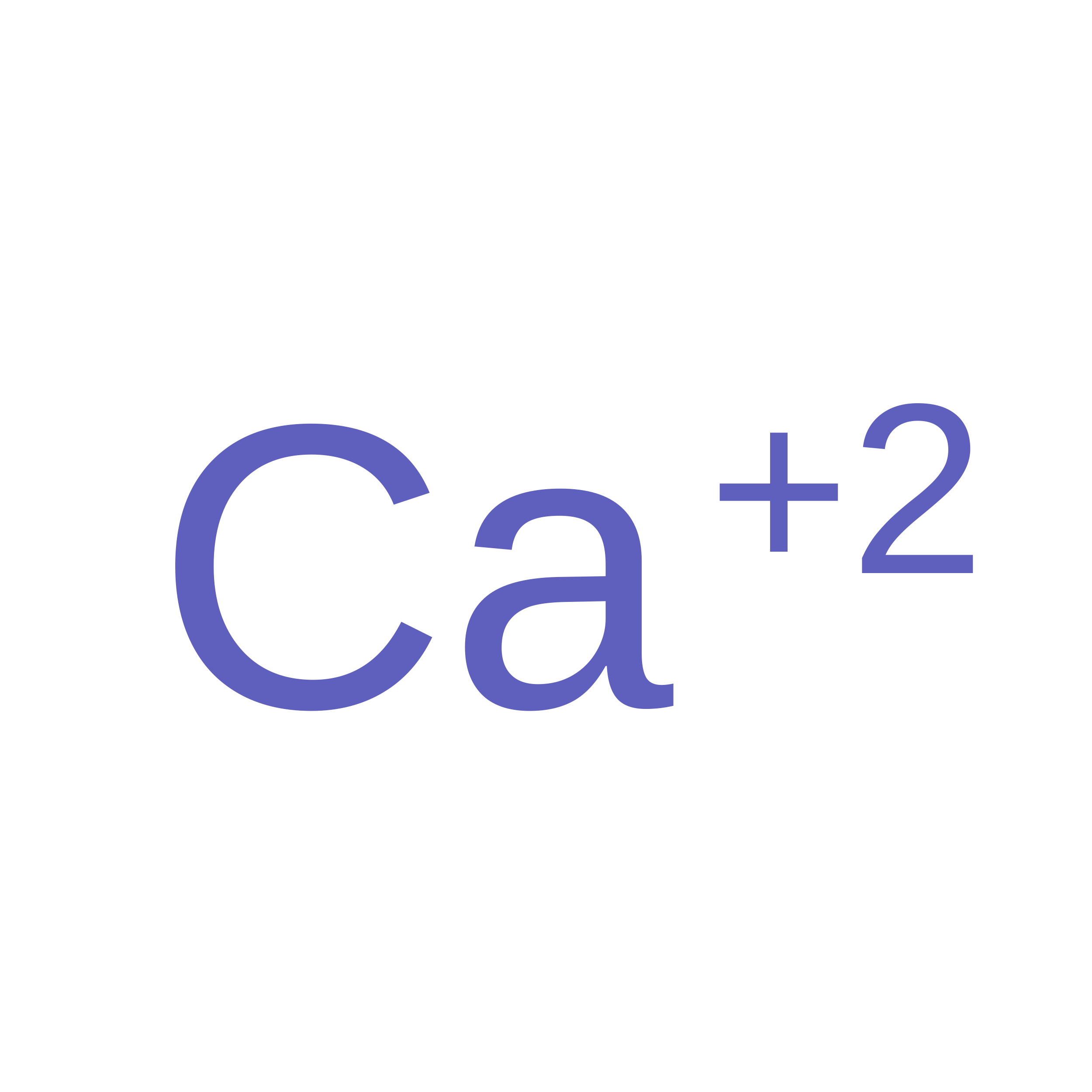
CA

Query on CA


Download:Ideal Coordinates CCD File
I [auth A],
K [auth B],
M [auth C],
O [auth D]
CALCIUM ION
Ca
BHPQYMZQTOCNFJ-UHFFFAOYSA-N

Experimental Data & Validation

Experimental Data

  • Method: X-RAY DIFFRACTION
  • Resolution: 2.70 Å
  • R-Value Free:  0.244 (Depositor), 0.248 (DCC) 
  • R-Value Work:  0.194 (Depositor), 0.203 (DCC) 
Space Group: P 21 21 2
Unit Cell:
Length ( Å )Angle ( ˚ )
a = 129.38α = 90
b = 126.922β = 90
c = 76.065γ = 90
Software Package:
Software NamePurpose
X-PLORmodel building
X-PLORrefinement
XDSdata reduction
XDSdata scaling
X-PLORphasing

Structure Validation

View Full Validation Report


Entry History 

Deposition Data

Revision History  (Full details and data files)

  • Version 1.0: 1999-07-27
    Type: Initial release
  • Version 1.1: 2008-04-26
    Changes: Version format compliance
  • Version 1.2: 2011-07-13
    Changes: Version format compliance
  • Version 1.3: 2017-10-04
    Changes: Refinement description
  • Version 1.4: 2019-11-20
    Changes: Database references, Derived calculations
  • Version 2.0: 2020-07-29
    Type: Remediation
    Reason: Carbohydrate remediation
    Changes: Atomic model, Data collection, Derived calculations, Structure summary
  • Version 2.1: 2023-12-27
    Changes: Data collection, Database references, Derived calculations, Structure summary
  • Version 2.2: 2024-04-03
    Changes: Refinement description