Download Mendeley
Damping amyloid-associated conformational fluctuations in a protein by an engineered diselenide bridge.
Yang, Y., Dhayalan, B., Ehnbom, A., Weil-Ktorza, O., Metanis, N., Weiss, M.A.(2026) Protein Sci 35: e70697-e70697
- PubMed: 42478539 Search on PubMedSearch on PubMed Central
- DOI: https://doi.org/10.1002/pro.70697
- Primary Citation Related Structures:
9ZDL - PubMed Abstract:
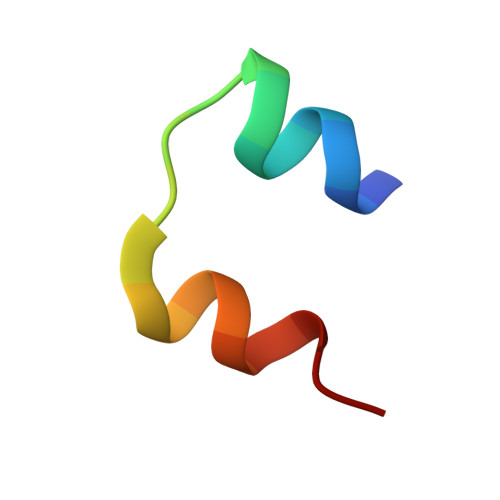
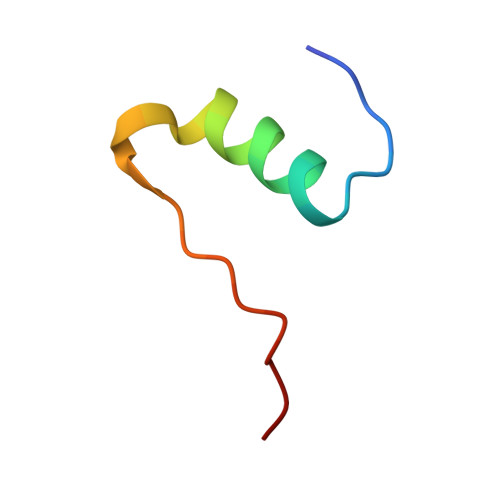
Polypeptide cross-β assembly, characteristic of diverse proteotoxic diseases, defines a general thermodynamic ground state and limits the shelf lives of peptide- and protein therapeutics. A model is provided by insulin. Although the hormone contains a predominance of α-helix, its fibrils exhibit cross-β reorganization. In the real world, aggregation-coupled fibrillation of insulin underlies its degradation above room temperature, impairing activity and imposing a complex global "cold chain" of transport and storage. Here, we describe biophysical protection of an insulin analog at an elevated temperature by an engineered diselenide bridge. Our studies focused on insulin glargine, the active ingredient of long-acting formulations in broad clinical use. Insoluble in a subcutaneous depot due to its shifted isoelectric point, the analog dissolves at pH 4.0 and so, unlike neutral formulations of the wild-type hormone, is unprotected by zinc-mediated hexamer assembly. Whereas at 37°C the fibrillation lag time of insulin glargine is accelerated by fourfold relative to WT insulin, such instability is circumvented by pairwise substitution of Cys A6 and Cys A11 by selenocysteine. Protection from fibrillation correlates with augmented resistance to pepsin cleavage, guanidine denaturation, and thermal unfolding. Although NMR structures of insulin glargine and its diselenide analog are similar, damping of conformational fluctuations is evidenced by patterns of 1 H-NMR chemical shifts, helix-associated NOEs, amide-resonance line widths, and 1 H- 2 H amide-proton exchange. Such damping is discussed in relation to molecular dynamics simulations. Demonstrating a likely mechanistic relationship between fibrillation and native-state conformational fluctuations, our findings highlight the translational promise of "dynamic engineering" via nonstandard mutagenesis.
- Department of Biochemistry, Molecular Biology & Pharmacology, Indiana University School of Medicine, Indianapolis, Indiana, USA.
Organizational Affiliation: