Download Mendeley
Insights into the recognition of cyclic alpha-(1→6)-glucan by a solute-binding protein of an ABC transporter from Tepidibacillus decaturensis.
Takei, S., Saburi, W., Yao, M., Mori, H., Ose, T.(2026) J Biol Chem 302: 111346-111346
- PubMed: 41791706 Search on PubMedSearch on PubMed Central
- DOI: https://doi.org/10.1016/j.jbc.2026.111346
- Primary Citation Related Structures:
9XF5, 9XFU - PubMed Abstract:
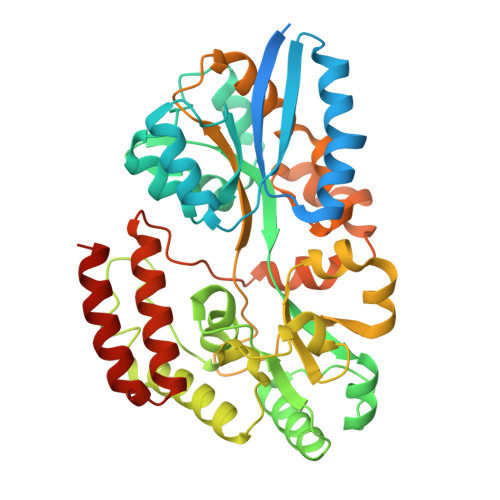
ABC transporters facilitate the translocation of various substrates across biological membranes. In prokaryotic ABC importers, the solute-binding protein, which selectively binds to a ligand, is incorporated into the functional complex. Cycloisomaltooligosaccharides (CIs) are produced from α-(1→6)-glucan by CI glucanotransferase and intracellularly degraded by CI-inducible dextranase. CIs are regarded as incorporated forms; however, their uptake mechanisms have not yet been elucidated. In this study, the solute-binding protein with a high affinity for CIs from Tepidibacillus decaturensis (TdCIBP) was discovered. TdCIBP showed the highest affinity for cycloisomaltoheptaose, followed by cycloisomaltooctaose and cycloisomaltononaose. TdCIBP also showed binding affinity for linear isomaltooligosaccharides (IGs) with a degree of polymerization ≥3 but preferred longer IGs. TdCIBP structures in complex with cycloisomaltooctaose and isomaltoheptaose were determined using X-ray crystallography at 1.6 Å and 1.9 Å resolutions, respectively. Of the modeled five d-glucosyl residues in isomaltoheptaose, the two d-glucosyl residues (the third and fourth residues from the reducing end) were bound to TdCIBP through numerous hydrogen bonding interactions in the same orientation as the corresponding d-glucosyl residues of cycloisomaltooctaose. The other d-glucosyl residues of isomaltoheptaose bind differently to the binding site than the corresponding d-glucosyl residues of cycloisomaltooctaose. As little difference was observed in the amino acid orientation of TdCIBP between the two complexes, cyclic and linear IGs were bound to TdCIBP by changing the combination of interacting amino acid residues. The high affinity to CIs and long IGs suggests that the ABC transporter cooperating with TdCIBP uptakes these sugars directly, contributing to sugar metabolism and minimizing ATP consumption.
- Faculty of Advanced Life Science, Hokkaido University, Sapporo, Japan.
Organizational Affiliation: