9WYD | pdb_00009wyd

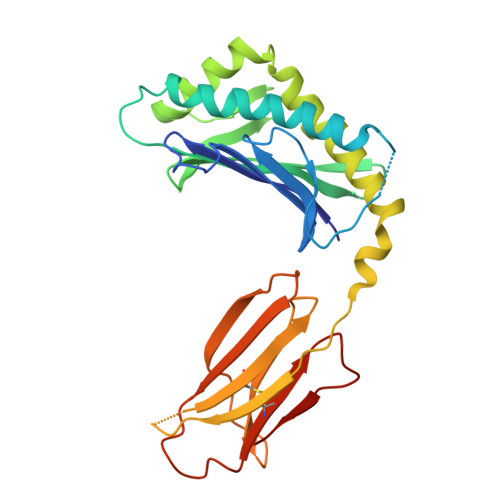
Crystal structure of HAstV8 spike and FcRn


Experimental Data Snapshot

  • Method: X-RAY DIFFRACTION
  • Resolution: 2.65 Å
  • R-Value Free: 
    0.232 (Depositor), 0.233 (DCC) 
  • R-Value Work: 
    0.187 (Depositor), 0.187 (DCC) 
  • R-Value Observed: 
    0.189 (Depositor) 

Starting Models: experimental
View more details

wwPDB Validation 3D Report Full Report

Validation slider image for 9WYD

This is version 1.1 of the entry. See complete history

Literature

The conserved human astrovirus-receptor interface reveals a targetable vulnerability for antiviral development.

Wang, W.Xu, Y.Li, Z.Liu, D.Ma, K.Wang, R.Chen, R.Shu, B.Sun, X.Liu, Y.Ke, X.Zhang, S.

(2026) Nat Commun 17

  • DOI: https://doi.org/10.1038/s41467-026-70465-5
  • Primary Citation Related Structures: 
    9WYD, 9WYE, 9WYG

  • PubMed Abstract: 

    Human astrovirus (HAstV) is a major cause of viral enteritis in children and the older adults worldwide. The eight serotypes of classical HAstVs (HAstV1-8), employ the neonatal Fc receptor (FcRn) as an entry receptor. To elucidate the receptor binding mechanism of HAstVs, we determined the crystal structure of the HAstV8 spike protein complexed with human FcRn. The structure reveals that the HAstV8 spike protein engaged FcRn via a conserved surface depression, which is also present across the other seven classical HAstVs serotypes. The binding interface of HAstV8 spike protein on FcRn largely overlaps with the footprints of three clinically approved FcRn blockers to treat an autoimmune disease. Accordingly, these FcRn inhibitors potently suppress astrovirus infection, significantly reducing viral RNA levels in astrovirus permissive Caco2 cells. Therefore, our study reports a conserved receptor recognition mechanism among human astroviruses and suggests the potential of repurposing clinically approved therapeutics to treat astrovirus infection.


  • Organizational Affiliation
    • College of Life Sciences, Nanjing Agricultural University, Nanjing, China.

Macromolecule Content 

  • Total Structure Weight: 68.3 kDa 
  • Atom Count: 4,581 
  • Modeled Residue Count: 568 
  • Deposited Residue Count: 605 
  • Unique protein chains: 3

Macromolecules

Find similar proteins by:|  3D Structure
Entity ID: 1
MoleculeChains  Sequence LengthOrganismDetailsImage
IgG receptor FcRn large subunit p51274Homo sapiensMutation(s): 0 
Gene Names: FCGRTFCRN
UniProt & NIH Common Fund Data Resources
Find proteins for P55899 (Homo sapiens)
Explore P55899 
Go to UniProtKB:  P55899
PHAROS:  P55899
GTEx:  ENSG00000104870 
Entity Groups
Sequence Clusters30% Identity50% Identity70% Identity90% Identity95% Identity100% Identity
UniProt GroupP55899
Sequence Annotations
Expand
Reference Sequence
Find similar proteins by:|  3D Structure
Entity ID: 2
MoleculeChains  Sequence LengthOrganismDetailsImage
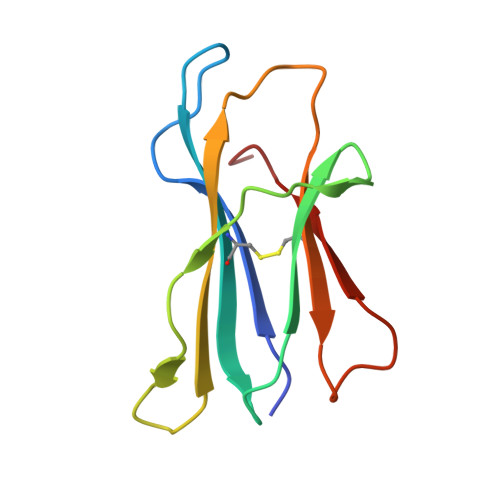
Beta-2-microglobulin99Homo sapiensMutation(s): 0 
Gene Names: B2MCDABP0092HDCMA22P
UniProt & NIH Common Fund Data Resources
Find proteins for P61769 (Homo sapiens)
Explore P61769 
Go to UniProtKB:  P61769
PHAROS:  P61769
GTEx:  ENSG00000166710 
Entity Groups
Sequence Clusters30% Identity50% Identity70% Identity90% Identity95% Identity100% Identity
UniProt GroupP61769
Sequence Annotations
Expand
Reference Sequence
Find similar proteins by:|  3D Structure
Entity ID: 3
MoleculeChains  Sequence LengthOrganismDetailsImage
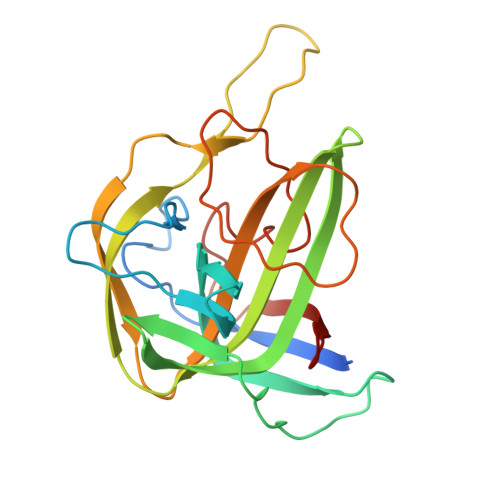
Spike protein VP27232Human astrovirus 8Mutation(s): 0 
Gene Names: ORF2
UniProt
Find proteins for Q9IFX1 (Human astrovirus-8)
Explore Q9IFX1 
Go to UniProtKB:  Q9IFX1
Entity Groups
Sequence Clusters30% Identity50% Identity70% Identity90% Identity95% Identity100% Identity
UniProt GroupQ9IFX1
Sequence Annotations
Expand
Reference Sequence

Experimental Data & Validation

Experimental Data

  • Method: X-RAY DIFFRACTION
  • Resolution: 2.65 Å
  • R-Value Free:  0.232 (Depositor), 0.233 (DCC) 
  • R-Value Work:  0.187 (Depositor), 0.187 (DCC) 
  • R-Value Observed: 0.189 (Depositor) 
Space Group: C 1 2 1
Unit Cell:
Length ( Å )Angle ( ˚ )
a = 173.12α = 90
b = 84.429β = 97.42
c = 53.953γ = 90
Software Package:
Software NamePurpose
PHENIXrefinement
XDSdata reduction
XDSdata scaling
PHASERphasing

Structure Validation

View Full Validation Report


Entry History 

& Funding Information

Deposition Data


Funding OrganizationLocationGrant Number
National Natural Science Foundation of China (NSFC)China32170158

Revision History  (Full details and data files)

  • Version 1.0: 2026-02-11
    Type: Initial release
  • Version 1.1: 2026-09-16
    Changes: Database references