Download Mendeley
Structural and mechanistic insights into OCTN1-mediated transport and cancer cell proliferation.
Xu, B., Liang, S., Wang, Z., Zhou, X., Wang, L., Liang, Q., Liu, X., Guo, W., Shi, S., Zhu, C., Ye, S., Lou, Z., Wang, Y.(2026) Nat Commun 17
- PubMed: 42875455 Search on PubMedSearch on PubMed Central
- DOI: https://doi.org/10.1038/s41467-026-77727-2
- Primary Citation Related Structures:
9WTX, 9WTY - PubMed Abstract:
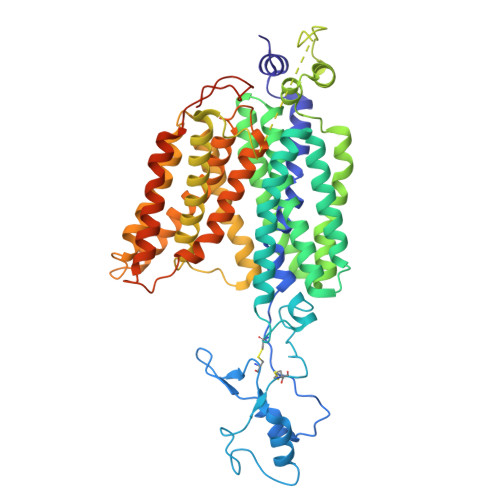
The Novel Organic Cation Transporter 1 (OCTN1) facilitates the uptake of endogenous metabolites and therapeutic drugs across diverse tissues. Recognized as a key transporter for the antioxidant ergothioneine (ET), OCTN1 also mediates the cellular entry and release of various cationic compounds. Dysregulation of OCTN1 has been implicated in cancer progression and drug interaction. In non-neuronal systems, OCTN1-mediated acetylcholine (ACh) transport has been implicated in promoting cancer progression by enhancing tumor cell proliferation and invasion. Despite its physiological and clinical relevance, the structural mechanisms underlying substrate recognition and transport by OCTN1 have remained poorly understood. Here, we present cryo-EM structures of human OCTN1 in both apo and ET-bound states, revealing the binding site of ET and elucidating conformational changes essential for sodium-dependent substrate transport. Furthermore, structure-based virtual screening identified mebendazole (MBZ) as a potent inhibitor targeting OCTN1, effectively suppressing the proliferation of cervical and lung cancer cells. Our findings provide a structural framework for understanding OCTN1 function and inform strategies to target this transporter in cancer.
- State Key Laboratory of Synthetic Biology, Haihe Laboratory of Sustainable Chemical Transformations, Tianjin Key Laboratory of Function and Application of Biological Macromolecular Structures, Faculty of Medicine, School of Life Sciences, Tianjin University, Tianjin, China. binghong_xu@tju.edu.cn.
Organizational Affiliation: