9TLO | pdb_00009tlo

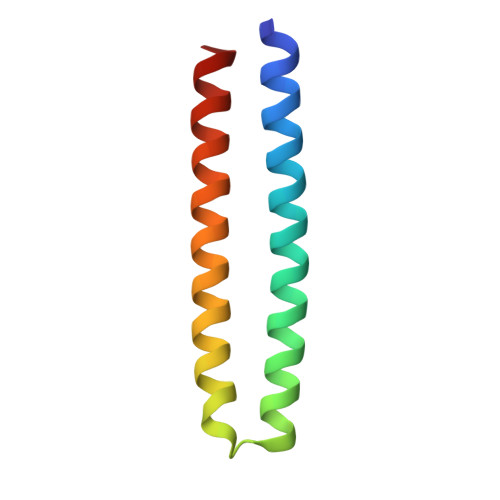
De novo designed single-chain antiparallel coiled-coil hairpin with binding site for BCL-xL, Sc-apCC-2-BCL-xL-5


Experimental Data Snapshot

  • Method: X-RAY DIFFRACTION
  • Resolution: 2.20 Å
  • R-Value Free: 
    0.247 (Depositor), 0.246 (DCC) 
  • R-Value Work: 
    0.212 (Depositor), 0.212 (DCC) 
  • R-Value Observed: 
    0.213 (Depositor) 

Starting Model: in silico
View more details

wwPDB Validation 3D Report Full Report

Validation slider image for 9TLO

This is version 1.1 of the entry. See complete history

Literature

De Novo-Designed Bifunctional Proteins for Targeted Protein Degradation.

Mylemans, B.Korona, B.Acevedo-Jake, A.M.MacRae, A.Edwards, T.A.Huang, D.T.Wilson, A.J.Itzhaki, L.S.Woolfson, D.N.

(2026) J Am Chem Soc 148: 34311-34319

  • DOI: https://doi.org/10.1021/jacs.6c07593
  • Primary Citation Related Structures: 
    9TLL, 9TLM, 9TLN, 9TLO, 9TLP, 9TLQ, 9TLR, 9TLS, 9TLT, 9TLU, 9TLV, 9TLW

  • PubMed Abstract: 

    In targeted protein degradation (TPD), specific subcellular proteins are removed by routing them to the ubiquitin-proteasome, autophagy, or lysosome machinery. For instance, proteolysis-targeting chimeras (PROTACs) are synthetic heterobifunctional small molecules that simultaneously bind the target and an E3 ubiquitin ligase to drive ubiquitination and degradation by the proteasome. Despite considerable success, designing such molecules is challenging, and the number of currently addressable ubiquitin E3 ligases is limited. Here, we design a heterobifunctional de novo protein to trigger the degradation of a common cancer target, resulting in a desired phenotypic output. First, we developed a highly stable and adaptable helix-turn-helix scaffold for presenting multiple binding sites. Next, we use computational protein design to incorporate and embellish hot-spot-binding sites to target the antiapoptotic mediators BCL-xL and MCL-1. We show a 75% success rate for creating submicromolar binders against these targets. Crystal structures of the complexes confirmed the designed binding poses. Then, we designed short linear motifs (SLiMs) into the loop of the scaffold to recruit KLHL20 and the ubiquitin ligase machinery. These designs have low micromolar affinity for KLHL20 comparable to that of the natural SLiMs. Moreover, the bifunctionalized proteins degrade BCL-xL in cells, leading to apoptosis.


  • Organizational Affiliation
    • School of Chemistry, University of Bristol, Cantock's Close, BristolBS8 1TS, U.K.

Macromolecule Content 

  • Total Structure Weight: 25.89 kDa 
  • Atom Count: 1,746 
  • Modeled Residue Count: 216 
  • Deposited Residue Count: 225 
  • Unique protein chains: 1

Macromolecules

Find similar proteins by:|  3D Structure
Entity ID: 1
MoleculeChains  Sequence LengthOrganismDetailsImage
Sc-apCC-2-BCL-xL-5
A, B, C
75synthetic constructMutation(s): 0 
Entity Groups
Sequence Clusters30% Identity50% Identity70% Identity90% Identity95% Identity100% Identity
Sequence Annotations
Expand
Reference Sequence

Experimental Data & Validation

Experimental Data

  • Method: X-RAY DIFFRACTION
  • Resolution: 2.20 Å
  • R-Value Free:  0.247 (Depositor), 0.246 (DCC) 
  • R-Value Work:  0.212 (Depositor), 0.212 (DCC) 
  • R-Value Observed: 0.213 (Depositor) 
Space Group: P 43 21 2
Unit Cell:
Length ( Å )Angle ( ˚ )
a = 69.57α = 90
b = 69.57β = 90
c = 112.756γ = 90
Software Package:
Software NamePurpose
PHENIXrefinement
DIALSdata reduction
Aimlessdata scaling
PHASERphasing

Structure Validation

View Full Validation Report


Entry History 

& Funding Information

Deposition Data


Funding OrganizationLocationGrant Number
Biotechnology and Biological Sciences Research Council (BBSRC)United KingdomBB/V006231/1
Biotechnology and Biological Sciences Research Council (BBSRC)United KingdomBB/V006703/1
Biotechnology and Biological Sciences Research Council (BBSRC)United KingdomBB/V008412/1
Biotechnology and Biological Sciences Research Council (BBSRC)United KingdomBB/V008412/2

Revision History  (Full details and data files)

  • Version 1.0: 2026-08-19
    Type: Initial release
  • Version 1.1: 2026-09-02
    Changes: Database references