Download Mendeley
Glyceraldehyde-3-phosphate dehydrogenase is inhibited by binding of Cu(I) to the essential active site cysteine.
Riboldi, G.P., Firth, S.J., Basle, A., Waldron, K.J.(2026) Arch Biochem Biophys 776: 110707-110707
- PubMed: 41419077
- DOI: https://doi.org/10.1016/j.abb.2025.110707
- Primary Citation of Related Structures:
9T7U - PubMed Abstract:
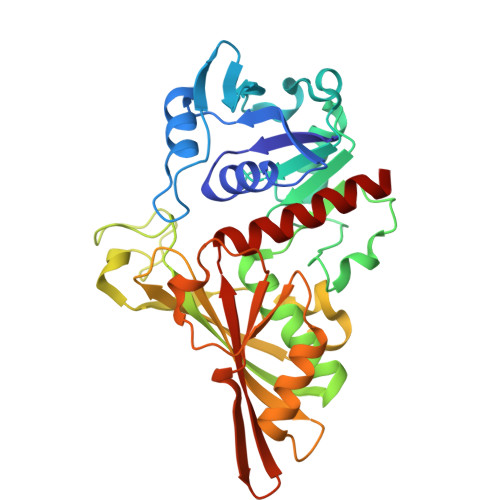
Copper is an essential micronutrient for bacteria, needed for important copper enzymes such as terminal respiratory oxidases. However, in excess, copper is toxic to bacteria. This toxicity is caused by its ability to bind tightly to proteins through the formation of Cu-Cys and Cu-His bonds. To control toxicity, bacteria have evolved homeostatic systems to safely handle the copper they need while efficiently sequestering and effluxing excess copper ions. We previously found that GapA, the abundant glycolytic glyceraldehyde-3-phosphate dehydrogenase enzyme in the Staphylococcus aureus cytosol, becomes associated with copper within cells cultured in medium containing excess copper. We found that this association of GapA with copper resulted in inhibition of its enzyme activity. Here, we have characterised this binding of copper ions to S. aureus GapA in vitro to determine the mechanism of copper inhibition of GapA. We found that purified recombinant GapA binds a single Cu(I) ion with high affinity. Crystallographic structural determination showed association of this copper ion with two active site residues, Cys151 and His178, known to be important for catalysis. This observation was confirmed by characterisation of mutated variants lacking these residues, which showed reduced ability to bind Cu(I) ions. Finally, we demonstrated that the cytosolic copper metallochaperone, CopZ, exhibits a tighter affinity for Cu(I) and can remove copper from GapA in vitro. Together, our data demonstrate the mechanism by which excess copper binds to the S. aureus GapA enzyme and irreversibly inhibit its activity and how the cellular homeostasis system is capable of resolving this inhibition.
- Biosciences Institute, Faculty of Medical Sciences, Newcastle University, Newcastle Upon Tyne, NE2 4HH, UK.
Organizational Affiliation: