9QXL | pdb_00009qxl

The structure of ADGRL4 in the active-state


Experimental Data Snapshot

  • Method: ELECTRON MICROSCOPY
  • Resolution: 3.14 Å
  • Aggregation State: PARTICLE 
  • Reconstruction Method: SINGLE PARTICLE 

wwPDB Validation   3D Report Full Report


This is version 1.1 of the entry. See complete history


Literature

Structure of the G q -coupled adhesion receptor ADGRL4.

Chen, Q.Gusach, A.Diamante, A.Patel, J.C.Edwards, P.C.Tate, C.G.Favara, D.M.

(2025) Nat Commun 17: 907-907

  • DOI: https://doi.org/10.1038/s41467-025-67629-0
  • Primary Citation of Related Structures:  
    9QXL

  • PubMed Abstract: 

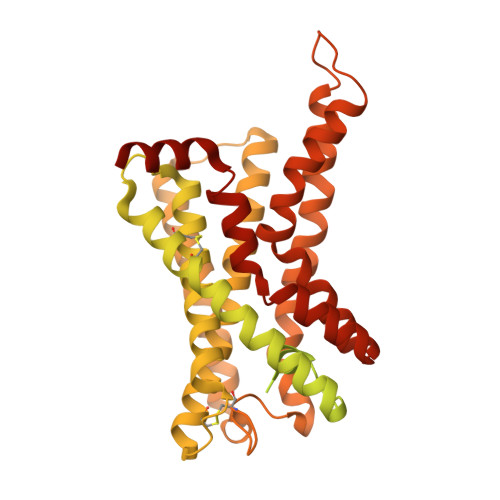
    Adhesion G protein-coupled receptors (aGPCRs) are a 32-member family of Class B GPCRs that have diverse cellular roles including mechanosensation, cell-fate determination, neurodevelopment, immune function and tumour biology. ADGRL4 is upregulated in the tumour microenvironment and is implicated in tumour pathogenesis across a broad range of malignancies. Inhibiting ADGRL4 is a potential therapeutic treatment for currently intractable cancers such as glioblastoma. Previous work suggested that ADGRL4 does not signal through G protein coupled pathways. However, using a sensitive bioluminescent assay, we demonstrate here that ADGRL4 couples weakly to the heterotrimeric G protein G q , whilst there is no robust coupling to other G proteins (G s , G 12 , G o ) or β-arrestin 1 or 2. We determine the cryo-EM structure of ADGRL4 coupled to a heterotrimeric G q complex to a resolution of 3.1 Å. The overall fold of ADGRL4 is similar to that of other aGPCRs, but the coupling to G q is distinct with fewer interactions between the receptor and G protein. The structure is consistent with ADGRL4 being activated by its tethered agonist and represents an important step towards the development of potential inhibitors for the treatment of multiple tumour types.


  • Organizational Affiliation
    • MRC Laboratory of Molecular Biology, Francis Crick Avenue, Cambridge, UK.

Macromolecules
Find similar proteins by:  (by identity cutoff)  |  3D Structure
Entity ID: 1
MoleculeChains Sequence LengthOrganismDetailsImage
Green fluorescent protein,Adhesion G protein-coupled receptor L4628Homo sapiensMutation(s): 0 
Gene Names: GFPADGRL4ELTD1ETLUNQ202/PRO228
UniProt & NIH Common Fund Data Resources
Find proteins for P42212 (Aequorea victoria)
Explore P42212 
Go to UniProtKB:  P42212
Find proteins for Q9HBW9 (Homo sapiens)
Explore Q9HBW9 
Go to UniProtKB:  Q9HBW9
PHAROS:  Q9HBW9
GTEx:  ENSG00000162618 
Entity Groups  
Sequence Clusters30% Identity50% Identity70% Identity90% Identity95% Identity100% Identity
UniProt GroupsP42212Q9HBW9
Sequence Annotations
Expand
  • Reference Sequence
Find similar proteins by:  (by identity cutoff)  |  3D Structure
Entity ID: 2
MoleculeChains Sequence LengthOrganismDetailsImage
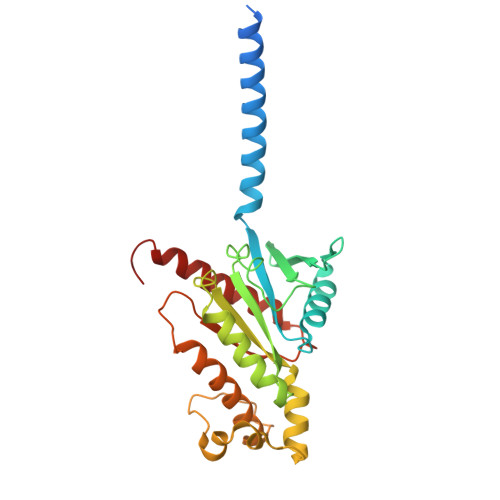
GNAS complex locus,Guanine nucleotide-binding protein G(s) subunit alpha isoforms short268Homo sapiensMutation(s): 0 
Gene Names: GNASGNAS1GSP
EC: 3.6.5
UniProt & NIH Common Fund Data Resources
Find proteins for P63092 (Homo sapiens)
Explore P63092 
Go to UniProtKB:  P63092
PHAROS:  P63092
GTEx:  ENSG00000087460 
Entity Groups  
Sequence Clusters30% Identity50% Identity70% Identity90% Identity95% Identity100% Identity
UniProt GroupP63092
Sequence Annotations
Expand
  • Reference Sequence
Find similar proteins by:  (by identity cutoff)  |  3D Structure
Entity ID: 3
MoleculeChains Sequence LengthOrganismDetailsImage
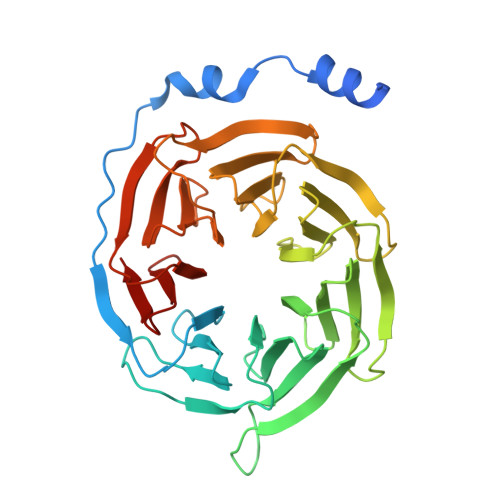
Guanine nucleotide-binding protein G(I)/G(S)/G(T) subunit beta-1348Homo sapiensMutation(s): 0 
Gene Names: GNB1
UniProt & NIH Common Fund Data Resources
Find proteins for P62873 (Homo sapiens)
Explore P62873 
Go to UniProtKB:  P62873
PHAROS:  P62873
GTEx:  ENSG00000078369 
Entity Groups  
Sequence Clusters30% Identity50% Identity70% Identity90% Identity95% Identity100% Identity
UniProt GroupP62873
Sequence Annotations
Expand
  • Reference Sequence
Find similar proteins by:  (by identity cutoff)  |  3D Structure
Entity ID: 4
MoleculeChains Sequence LengthOrganismDetailsImage
Guanine nucleotide-binding protein G(I)/G(S)/G(O) subunit gamma-2D [auth E]71Homo sapiensMutation(s): 0 
Gene Names: GNG2
UniProt & NIH Common Fund Data Resources
Find proteins for P59768 (Homo sapiens)
Explore P59768 
Go to UniProtKB:  P59768
PHAROS:  P59768
GTEx:  ENSG00000186469 
Entity Groups  
Sequence Clusters30% Identity50% Identity70% Identity90% Identity95% Identity100% Identity
UniProt GroupP59768
Sequence Annotations
Expand
  • Reference Sequence
Experimental Data & Validation

Experimental Data

  • Method: ELECTRON MICROSCOPY
  • Resolution: 3.14 Å
  • Aggregation State: PARTICLE 
  • Reconstruction Method: SINGLE PARTICLE 
EM Software:
TaskSoftware PackageVersion
MODEL REFINEMENTPHENIX1.21_5207:
RECONSTRUCTIONcryoSPARC

Structure Validation

View Full Validation Report


Entry History & Funding Information

Deposition Data


Funding OrganizationLocationGrant Number
Cancer Research UKUnited KingdomRCCPOB-May22 - 100008

Revision History  (Full details and data files)

  • Version 1.0: 2026-01-14
    Type: Initial release
  • Version 1.1: 2026-02-18
    Changes: Data collection, Database references