Download Mendeley
Docking of virtual libraries identifies small-molecule agonists of neurotensin receptors with analgesic activity.
Panel, N., Vo, D.D., Hubner, H., Deluigi, M., Pach, S., Belair, F., Weikert, D., Klenk, C., Hilge, M., Shiva, N., Brochu, I., Longpre, J.M., Ballgren, F., Saleh, A., Hu, H., Kapla, J., Kampen, S., Cabeza de Vaca, I., Kihlberg, J., Wettschureck, N., Sarret, P., Pluckthun, A., Gmeiner, P., Carlsson, J.(2026) Nat Commun 17
- PubMed: 42486867 Search on PubMedSearch on PubMed Central
- DOI: https://doi.org/10.1038/s41467-026-74990-1
- Primary Citation Related Structures:
9QC1, 9QD4 - PubMed Abstract:
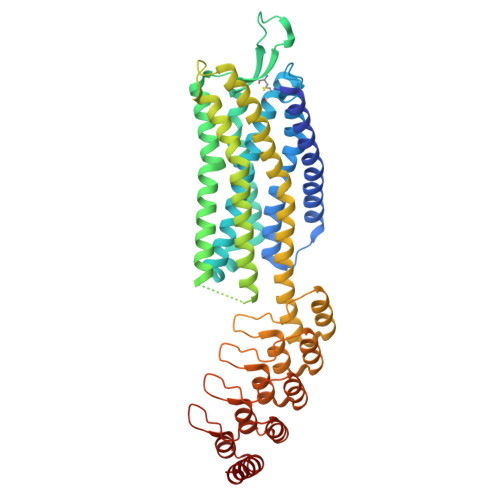
Peptide-activated G protein-coupled receptors (GPCRs) play crucial roles in numerous diseases, but remain difficult therapeutic targets due to the challenges in developing small-molecule drugs. Here, we explore structure-based strategies to identify small-molecule agonists of neurotensin (NTS) receptors, which hold promise for developing non-opioid analgesics. Chemical libraries of drug-like molecules are first designed based on a receptor-peptide complex, and then 14.5 million compounds are computationally docked to the orthosteric binding site of the NTS 1 receptor. A set of 39 top-ranked compounds is synthesized, and seven of these are experimentally confirmed to activate the NTS 1 receptor. Structure-guided optimization yields NTS 1 ligands with signaling signatures distinct from the endogenous peptide, and these compounds also exhibit high affinity for the NTS 2 receptor. High-resolution crystal structures of two agonists bound to the NTS 1 receptor confirm predicted binding modes and reveal key determinants of activation. In vivo, the compounds produce robust antinociception in rodents without inducing hypotension, consistent with a contribution of NTS 2 receptor activity. To facilitate broader application of our virtual screening approach to peptide-binding GPCRs, we provide access to tailored chemical libraries containing billions of readily synthesizable compounds.
- Science for Life Laboratory, Department of Cell and Molecular Biology, Uppsala University, Uppsala, Sweden.
Organizational Affiliation: