Download Mendeley
Molecular mechanism of exchange coupling in CLC chloride/proton antiporters.
Aydin, D., Chien, C.T., Kreiter, J., Nava, A.R., Portasikova, J.M., Fojtik, L., Sobecks, B.L., Mosquera, C., Man, P., Dror, R.O., Chiu, W., Maduke, M.(2026) Nat Commun
- PubMed: 41507156
- DOI: https://doi.org/10.1038/s41467-025-68098-1
- Primary Citation of Related Structures:
9O95, 9O96, 9O97, 9O98 - PubMed Abstract:
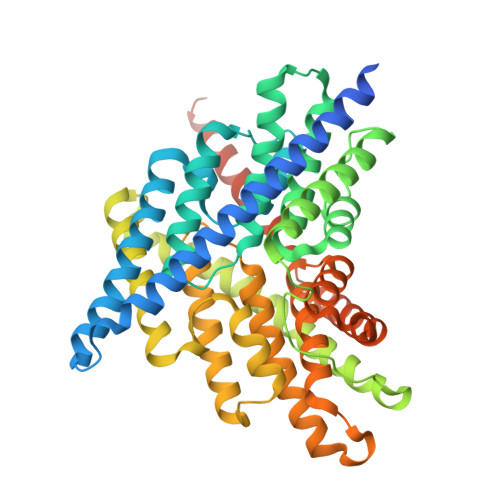
The ubiquitous CLC membrane transporters are unique in their ability to exchange anions for cations. Despite extensive study, there is no mechanistic model that fully explains their 2:1 Cl ‒ /H + stoichiometric exchange mechanism. Here, we provide such a model. Using differential hydrogen-deuterium exchange mass spectrometry, cryo-EM structure determination, and molecular dynamics simulations, we uncovered conformational dynamics in CLC-ec1, a bacterial CLC homolog that has served as a paradigm for this family of transporters. Simulations based on a cryo-EM structure at pH 3 revealed critical steps in the transport mechanism, including release of Cl ‒ ions to the extracellular side, opening of the inner gate, and water wires that facilitate H + transport. Surprisingly, these water wires occurred independently of Cl ‒ binding, prompting us to reassess the relationship between Cl ‒ binding and Cl ‒ /H + coupling. Using isothermal titration calorimetry and quantitative flux assays on mutants with reduced Cl ‒ binding affinity, we conclude that, while Cl ‒ binding is necessary for coupling, even weak binding can support Cl ‒ /H + coupling. By integrating our findings with existing literature, we establish a complete and efficient CLC 2:1 Cl ‒ /H + exchange mechanism.
- Department of Molecular and Cellular Physiology, Stanford University, Stanford, CA, USA.
Organizational Affiliation: