Download Mendeley
Inhibition of ice recrystallization with designed twistless helical repeat proteins.
de Haas, R.J., Pyles, H., Huddy, E.B., van Ossenbruggen, J., Zheng, C., van den Broek, D., Giezen, S.N., Carr, A., Bera, A.K., Kang, A., Brackenbrough, E., Joyce, E., Sankaran, B., Baker, D., Voets, I.K., de Vries, R.(2025) Proc Natl Acad Sci U S A 122: e2514871122-e2514871122
- PubMed: 41289379
- DOI: https://doi.org/10.1073/pnas.2514871122
- Primary Citation of Related Structures:
9D01, 9MG8 - PubMed Abstract:
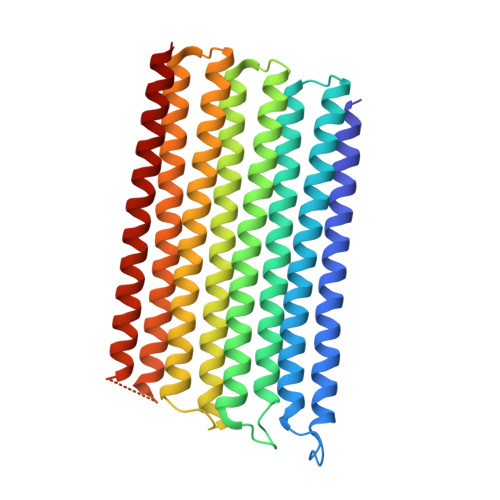
Given the repetitive structure of crystalline ice, it is unsurprising that highly active ice-binding proteins (IBPs), often with beta-roll structures, also have repeating motifs. Here, we introduce a de novo designed family of ice-binding twistless alpha-helical repeat (iTHR) proteins. Each iTHR protein comprises two planar layers of parallel alpha-helices connected by loops-a structural topology not seen in native IBPs. The ice-binding helices contain an ordered array of TXXXAXXXAXX motifs, precisely spaced to complement the pyramidal {201} and secondary prism {110} planes of the ice lattice, with a designed 98.2° residue turn angle that orients all threonines uniformly toward the ice surface. iTHR proteins show high solubility, thermostability, and produce varied ice crystal morphologies depending on their intended target facet. Crucially, iTHRs exhibit ice recrystallization inhibition (IRI) at critical concentrations comparable to those of many native globular IBPs. Extensive site-specific mutagenesis shows that ice-binding activity in iTHR proteins is robust, remaining largely unaffected by changes in chemical composition. Variation in the repeat number reveals a nonmonotonic relationship to IRI activity. X-ray crystal structures of two designs confirm the intended orientation of threonines, uniformly pointing toward the ice surface. The iTHR family provides a versatile platform to systematically investigate the complex structure-activity relationships underlying protein-ice interactions.
- Department of Physical Chemistry and Soft Matter, Wageningen University and Research, Wageningen 6078 WE, The Netherlands.
Organizational Affiliation: