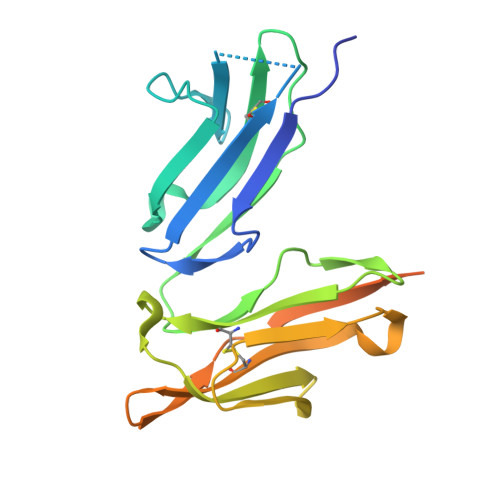
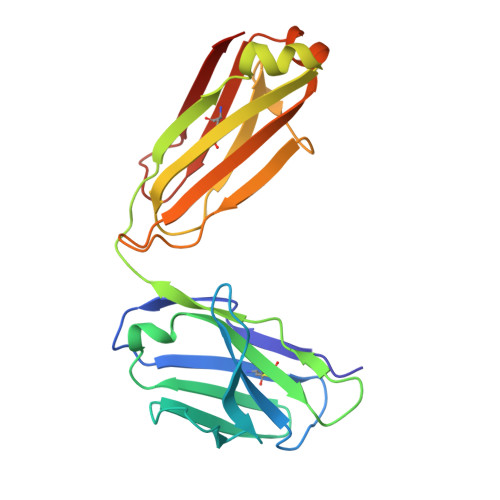
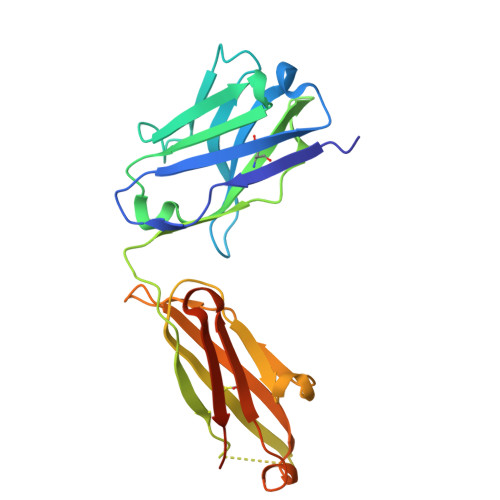
Download Mendeley
Chimeras co-targeting antigens and Fc gamma RIIb trigger degradation of extracellular soluble proteins and pathological aggregates.
Du, M., Li, N., Li, T., Zhao, Z., Liu, H., Li, X., Gong, N., Duan, B., Wang, W., Jian, Y., Ma, W., Zhang, X., Wang, Y., Zhang, Z., Bai, Y., Wang, X., Wang, C., Liu, J., Guan, X., Zhou, F., Wang, W., Li, L., Zhu, X., Lei, Y., Duan, Y., Han, G., Wei, P., Gao, S., Wang, S., Chen, A., Huang, Y., Yang, H., Xue, X., Zhang, H.(2025) Nat Commun 17: 514-514
- PubMed: 41372196
- DOI: https://doi.org/10.1038/s41467-025-67207-4
- Primary Citation of Related Structures:
9M5B - PubMed Abstract:
While the clinical utility of conventional antibody therapies is undeniable, their therapeutic potential is often constrained high antigen loads and the recycling of antibody-antigen complexes via neonatal Fc receptor (FcRn). Here, we present a platform, based on a design similar to bispecific antibodies, FcγRIIb-Targeting Chimeras (FcRTAC). These constructs recognise antigens with one arm and bind FcγRIIb with the other arm to harness the unique endocytic properties of FcγRIIb to direct the recognized pathogenic antigens to lysosomes for irreversible degradation. The FcRTAC platform demonstrates broad therapeutic potential across multiple disease-relevant targets, including IgE, proprotein convertase subtilisin/kexin type 9 (PCSK9) and amyloid-β (Aβ). Notably, a single intravenous administration of blood brain barrier (BBB)-penetrating adeno-associated viral vector (AAV) encoding an Aβ-targeting FcRTAC construct achieves sustained therapeutic effects, establishing proof-of-concept for AAV-mediated delivery of an Aβ degrader as a strategy for Alzheimer's disease treatment. Our comprehensive investigation of binding properties of FcRTACs reveals critical molecular determinants of function and enables development of optimized engineering approaches. In summary, our approach represents a versatile therapeutic platform for treating diverse diseases ranging from autoimmune disorders to neurodegenerative conditions, while simultaneously serving as a user-friendly, plug-and-play research tool for extracellular protein knockout in basic biological research.
- Shanghai Institute for Advanced Immunochemical Studies, ShanghaiTech University, Shanghai, PR China.
Organizational Affiliation: