9IAS | pdb_00009ias

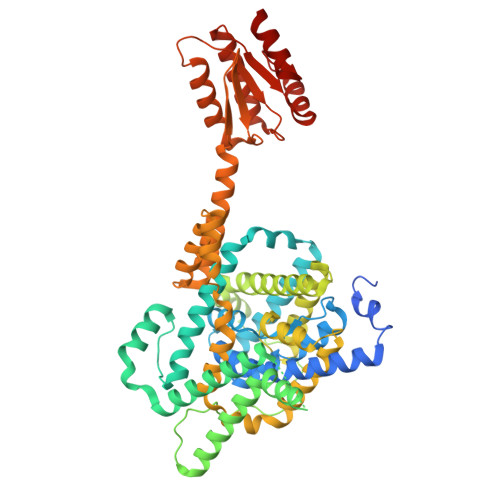
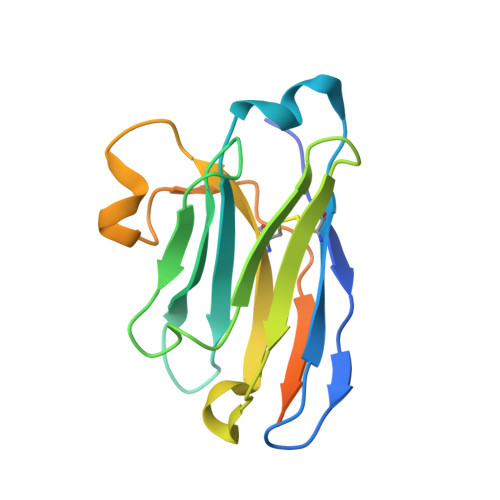
Sulfate transporter SLC26A11 in nanodiscs with nanobody Nb4


Experimental Data Snapshot

  • Method: ELECTRON MICROSCOPY
  • Resolution: 2.80 Å
  • Aggregation State: PARTICLE 
  • Reconstruction Method: SINGLE PARTICLE 

wwPDB Validation 3D Report Full Report

Validation slider image for 9IAS

This is version 1.1 of the entry. See complete history

Literature

SLC26A11 is an atypical solute carrier with dual transport-channel function mediating lysosomal sulfate transport.

Kuhn, B.T.Kovermann, P.Haddad, B.G.Rasmussen, T.Hove, T.T.Bungert-Plumke, S.Bottcher, B.Machtens, J.P.Fahlke, C.Geertsma, E.R.

(2026) Nat Commun 17

  • DOI: https://doi.org/10.1038/s41467-026-75749-4
  • Primary Citation Related Structures: 
    9IAR, 9IAS

  • PubMed Abstract: 

    Membrane transporters and channels are generally assumed to be based on distinct structural and functional principles. SLC26A11, a solute carrier with high expression levels in the brain, has been proposed to function as either an anion transporter or a channel. Here, we resolve this apparent discrepancy by demonstrating that SLC26A11 is a dual-function protein capable of operating as both a sulfate transporter and a chloride channel. By resolving its structure and combining biochemical studies and molecular dynamics simulations, we show that SLC26A11 exhibits all the hallmarks of a secondary transporter. The mechanistic basis for its selective ion transport identifies the protein as the elusive lysosomal sulfate exporter. Additionally, we demonstrate that SLC26A11 exhibits an uncoupled, channel-like chloride conductance gated by proton:sulfate symport. Our finding that the chloride-conducting state arises from the transport cycle may contribute to the development of therapeutic strategies for treating brain edema, and the identification of its role in lysosome sulfate efflux may provide new approaches to study and treat lysosomal storage diseases.


  • Organizational Affiliation
    • Max Planck Institute of Molecular Cell Biology and Genetics, Dresden, Germany.

Macromolecule Content 

  • Total Structure Weight: 161.09 kDa 
  • Atom Count: 10,176 
  • Modeled Residue Count: 1,316 
  • Deposited Residue Count: 1,476 
  • Unique protein chains: 2

Macromolecules

Find similar proteins by:|  3D Structure
Entity ID: 1
MoleculeChains  Sequence LengthOrganismDetailsImage
Sodium-independent sulfate anion transporter
A, B
583Homo sapiensMutation(s): 0 
Gene Names: SLC26A11
UniProt & NIH Common Fund Data Resources
Find proteins for Q86WA9 (Homo sapiens)
Explore Q86WA9 
Go to UniProtKB:  Q86WA9
PHAROS:  Q86WA9
GTEx:  ENSG00000181045 
Entity Groups
Sequence Clusters30% Identity50% Identity70% Identity90% Identity95% Identity100% Identity
UniProt GroupQ86WA9
Sequence Annotations
Expand
Reference Sequence
Find similar proteins by:|  3D Structure
Entity ID: 2
MoleculeChains  Sequence LengthOrganismDetailsImage
nanobody Nb4
C, D
155Vicugna pacosMutation(s): 0 
Entity Groups
Sequence Clusters30% Identity50% Identity70% Identity90% Identity95% Identity100% Identity
Sequence Annotations
Expand
Reference Sequence

Experimental Data & Validation

Experimental Data

  • Method: ELECTRON MICROSCOPY
  • Resolution: 2.80 Å
  • Aggregation State: PARTICLE 
  • Reconstruction Method: SINGLE PARTICLE 
EM Software:
TaskSoftware PackageVersion
MODEL REFINEMENTPHENIX1.20.1
RECONSTRUCTIONcryoSPARC4.4

Structure Validation

View Full Validation Report


Entry History 

& Funding Information

Deposition Data


Funding OrganizationLocationGrant Number
German Research Foundation (DFG)Germany359471283
German Research Foundation (DFG)Germany456578072
German Research Foundation (DFG)Germany525040890
German Research Foundation (DFG)GermanyFOR5046 GE 2841/3-1
German Research Foundation (DFG)GermanyFOR5046 GE 2841/2-1

Revision History  (Full details and data files)

  • Version 1.0: 2026-03-04
    Type: Initial release
  • Version 1.1: 2026-09-16
    Changes: Data collection, Database references