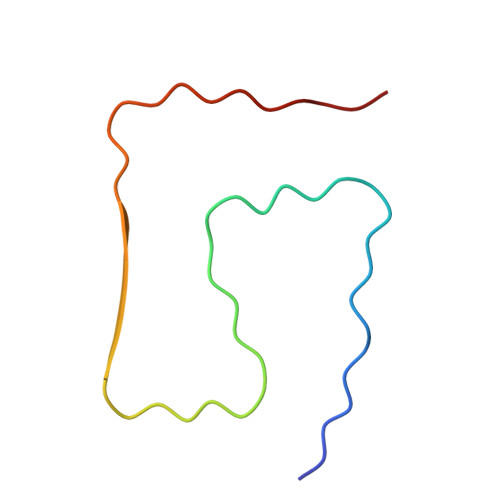
8SPA | pdb_00008spa

Structural insights into cellular control of the human CPEB3 prion, functionally regulated by a labile-amyloid-forming segment


Experimental Data Snapshot

  • Method: ELECTRON MICROSCOPY
  • Resolution: 3.00 Å
  • Aggregation State: FILAMENT 
  • Reconstruction Method: HELICAL 

wwPDB Validation   3D Report Full Report


This is version 1.2 of the entry. See complete history


Literature

Structural insights into functional regulation of the human CPEB3 prion by an amyloid-forming segment.

Flores, M.D.Sawaya, M.R.Boyer, D.R.Zink, S.Tovmasyan, S.Saucedo, A.Richards, L.S.Zee, C.T.Cardenas, J.Fioriti, L.Rodriguez, J.A.

(2025) Structure 33: 1314-1324.e5

  • DOI: https://doi.org/10.1016/j.str.2025.05.007
  • Primary Citation of Related Structures:  
    8SPA

  • PubMed Abstract: 

    The cytoplasmic polyadenylation-element-binding-protein-3 (CPEB3) is a functional prion thought to modulate protein synthesis and enable consolidation of long-term memory in neurons. We report a cryoelectron microscopy (cryo-EM) structure of amyloid fibrils grown in vitro from the first prion-like domain of human CPEB3 (hCPEB3), revealing their ordered 49-residue core, spanning L103 to F151. CPEB3 lacking that segment coalesces into abnormal puncta in cells compared to wild-type CPEB3, localizes away from dormant p-bodies and toward stress granules, and lacks the ability to influence protein synthesis in neurons. Fluorescence-guided cryo-focused ion beam (cryo-FIB) milling and cryo-electron tomography (cryo-ET) applied to neuronal cells expressing CPEB3 reveal CPEB3-GFP signal from lamellae enriched in multivesicular bodies (MVBs), cavernous multilamellar compartments, and bundled filaments, suggesting a state of induced cellular stress. Accordingly, cells expressing wild-type CPEB3 are less viable than those expressing CPEB3 without its amyloid core, suggesting human CPEB3 regulation may be required to overcome the liability associated with its self-assembly in cells.


  • Organizational Affiliation
    • Department of Chemistry and Biochemistry, UCLA-DOE Institute for Genomics and Proteomics, STROBE, NSF Science and Technology Center, University of California, Los Angeles (UCLA), Los Angeles, CA 90095, USA. Electronic address: mflores@mbi.ucla.edu.

Macromolecules
Find similar proteins by:  (by identity cutoff)  |  3D Structure
Entity ID: 1
MoleculeChains Sequence LengthOrganismDetailsImage
Cytoplasmic polyadenylation element-binding protein 3
A, B, C, D, E
49Homo sapiensMutation(s): 0 
Gene Names: CPEB3KIAA0940
UniProt & NIH Common Fund Data Resources
Find proteins for Q8NE35 (Homo sapiens)
Explore Q8NE35 
Go to UniProtKB:  Q8NE35
PHAROS:  Q8NE35
GTEx:  ENSG00000107864 
Entity Groups  
Sequence Clusters30% Identity50% Identity70% Identity90% Identity95% Identity100% Identity
UniProt GroupQ8NE35
Sequence Annotations
Expand
  • Reference Sequence
Experimental Data & Validation

Experimental Data

  • Method: ELECTRON MICROSCOPY
  • Resolution: 3.00 Å
  • Aggregation State: FILAMENT 
  • Reconstruction Method: HELICAL 
EM Software:
TaskSoftware PackageVersion
MODEL REFINEMENTPHENIX
RECONSTRUCTIONRELION3

Structure Validation

View Full Validation Report


Entry History & Funding Information

Deposition Data


Funding OrganizationLocationGrant Number
National Institutes of Health/National Institute of General Medical Sciences (NIH/NIGMS)United StatesGM128867
National Institutes of Health/National Institute of General Medical Sciences (NIH/NIGMS)United StatesGM1295410
National Institutes of Health/National Institute of General Medical Sciences (NIH/NIGMS)United StatesGM007185
National Science Foundation (NSF, United States)United StatesDMR-1548924
The Pew Charitable TrustsUnited StatesJAR
David and Lucile Packard FoundationUnited StatesJAR

Revision History  (Full details and data files)

  • Version 1.0: 2024-05-08
    Type: Initial release
  • Version 1.1: 2025-05-21
    Changes: Data collection, Structure summary
  • Version 1.2: 2026-03-11
    Changes: Data collection, Database references