Download Mendeley
Structural insights into the binding of CX-5461 and MTR-106 to G-quadruplex DNA.
Li, Y., Liu, K., Hu, X., Deng, J., Lan, W., Xue, H., Tang, W., Cao, C.(2026) Nucleic Acids Res 54
- PubMed: 42406628 Search on PubMedSearch on PubMed Central
- DOI: https://doi.org/10.1093/nar/gkag667
- Primary Citation Related Structures:
26JR, 26JT - PubMed Abstract:
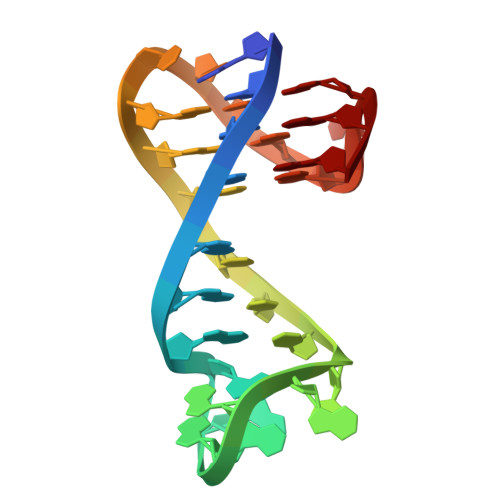
Small-molecule stabilization of G-quadruplexes (G4s) has become an active focus in nucleic acid-targeted drug discovery. The mechanisms of the ligands' binding selectivity and biological activities are critical for rational drug design. CX-5461, the first clinically advanced G4-targeting agent, has shown notable efficacy in DNA repair-deficient cancers. Its close analogue MTR-106 also displayed comparable anti-proliferative effects on cancer cells. However, the molecular basis of their interaction with G4s remains elusive. Here, through differential scanning calorimetry, complementary biophysical assays, and solution NMR technique, we probed their recognition modes with G4s. Although both ligands induced stronger thermal stabilization of the parallel G4s, the MYT1L quadruplex-duplex hybrid (QDH) formed the most homogeneous ligand-bound complexes in solution, highlighting the G4-duplex junction as a potential recognition site. Solution structural determination at high resolution demonstrated that both CX-5461 and MTR-106 inserted into the G4-duplex junction pocket. Their rigid polyaromatic scaffolds stacked with the 3'-end G-tetrad of G4, while their flexible side chains extended into the groove of QDH to enable spatial recognition. These findings elucidated the molecular basis of G4 recognition by CX-5461 and MTR-106, and provided a structural framework for the rational development of next-generation G4-targeted therapeutics with improved selectivity and efficacy.
- State Key Laboratory of Chemical Biology, Shanghai Institute of Organic Chemistry, University of Chinese Academy of Sciences, Chinese Academy of Sciences, 345 Lingling Road, Shanghai 200032, China.
Organizational Affiliation: