24YQ | pdb_000024yq

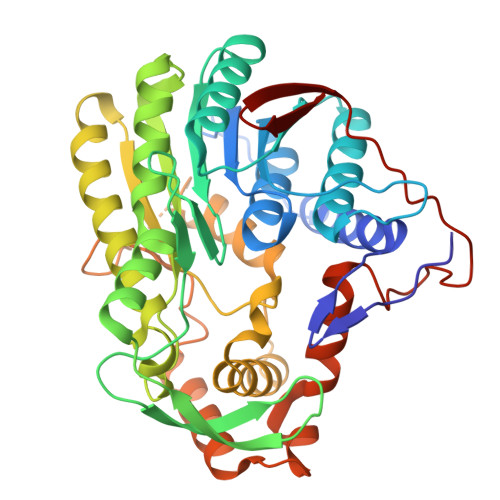
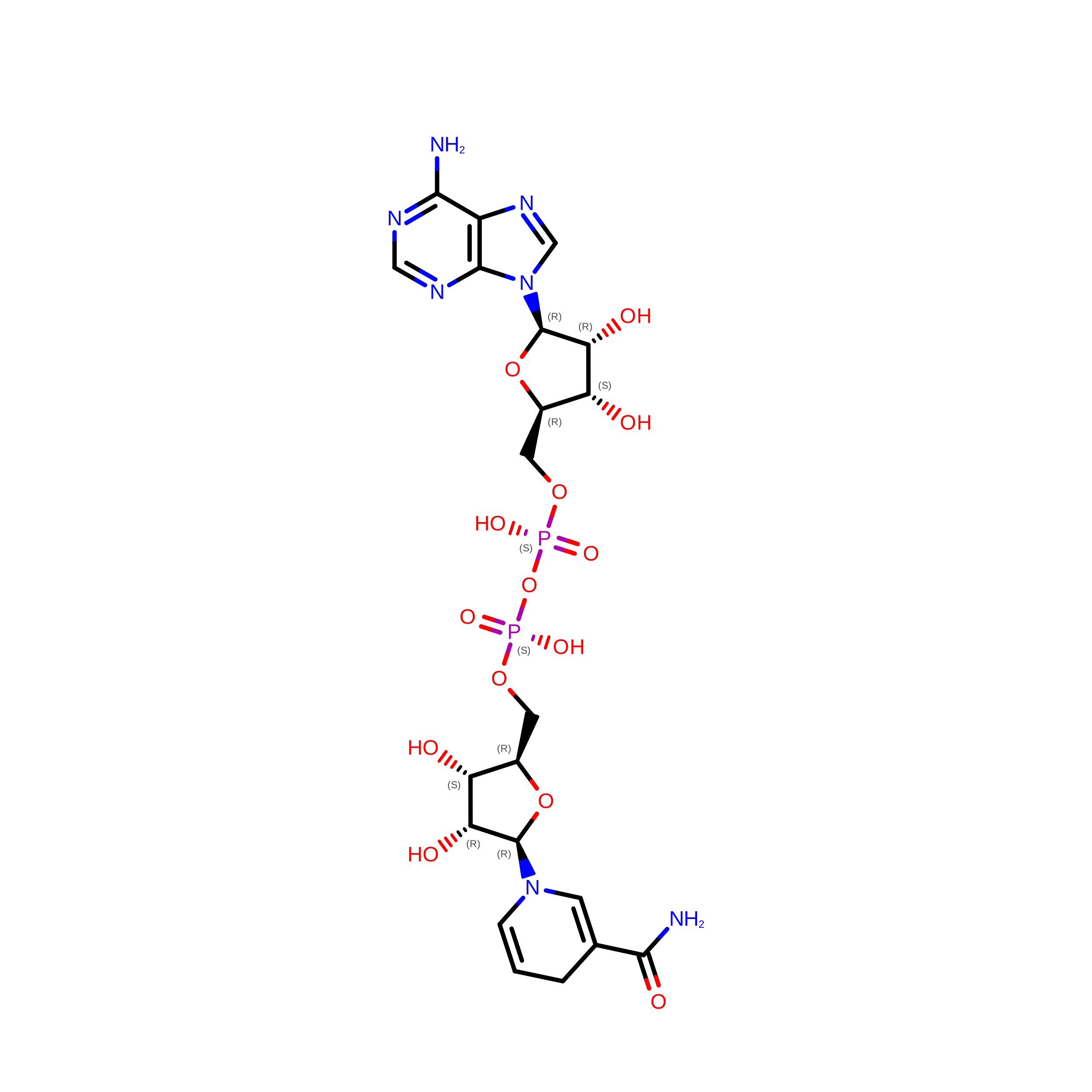
Crystal structure of Enoyl-ACP reducatase FabV from Peterkaempfera bronchialis with NADH cofactor


Experimental Data Snapshot

  • Method: X-RAY DIFFRACTION
  • Resolution: 1.96 Å
  • R-Value Free: 
    0.293 (Depositor), 0.290 (DCC) 
  • R-Value Work: 
    0.239 (Depositor), 0.240 (DCC) 
  • R-Value Observed: 
    0.241 (Depositor) 

Starting Model: in silico
View more details

wwPDB Validation 3D Report Full Report

Validation slider image for 24YQ

Ligand Structure Quality Assessment 


This is version 1.1 of the entry. See complete history

Literature

Iterative Enoyl Reduction by a FabV-Family Enzyme Expands the Chemical Landscape of Discrete Polyketide Synthases.

Gao, Y.Jiang, K.Dai, Y.Chen, H.Wang, Q.Li, D.Yan, X.Wei, G.Lin, Z.Chen, H.Deng, Z.Qu, X.

(2026) J Am Chem Soc 148: 36152-36164

  • DOI: https://doi.org/10.1021/jacs.6c11267
  • Primary Citation Related Structures: 
    24YK, 24YQ

  • PubMed Abstract: 

    Polyketides are a structurally diverse class of natural products with immense therapeutic potential. However, the biosynthetic output of discrete polyketide synthases (PKSs) has been constrained by a fundamental functional limitation: unlike modular Type I systems, discrete PKS systems typically lack integrated enoyl reductase (ER) activity. This constraint restricts their chemical repertoire primarily to unsaturated polyenes or aromatic scaffolds. Here, we characterize PbrC16, a FabV-family ER from a manumycin-type biosynthetic gene cluster (BGC) in Peterkaempfera bronchialis. This enzyme represents the first experimentally validated ER capable of functioning within discrete PKS architectures. In vitro biochemical reconstitution demonstrates that PbrC16 along with its homologue ScFabV catalyze iterative enoyl reductions in both β-ketoacyl-acyl carrier protein synthase III (KAS III)-dependent and highly reducing (HR) Type II PKS contexts, enabling the complete saturation of long-chain polyketide intermediates. Structural and computational analyses reveal the molecular basis for its exceptional substrate promiscuity and versatile acyl carrier protein (ACP) recognition. These findings resolve a long-standing "reductive gap" in discrete PKS biology and provide a "plug-and-play" module for the rational engineering of saturated polyketide scaffolds.


  • Organizational Affiliation
    • State Key Laboratory of Microbial Metabolism and School of Life Sciences and Biotechnology, Shanghai Jiao Tong University, Shanghai200240, China.

Macromolecule Content 

  • Total Structure Weight: 90.11 kDa 
  • Atom Count: 6,519 
  • Modeled Residue Count: 809 
  • Deposited Residue Count: 834 
  • Unique protein chains: 1

Macromolecules

Find similar proteins by:|  3D Structure
Entity ID: 1
MoleculeChains  Sequence LengthOrganismDetailsImage
trans-2-enoyl-CoA reductase (NAD(+))
A, B
417Peterkaempfera bronchialisMutation(s): 0 
Gene Names: fabVC7M71_007285
EC: 1.3.1.44
UniProt
Find proteins for A0A345SU67 (Peterkaempfera bronchialis)
Explore A0A345SU67 
Go to UniProtKB:  A0A345SU67
Entity Groups
Sequence Clusters30% Identity50% Identity70% Identity90% Identity95% Identity100% Identity
UniProt GroupA0A345SU67
Sequence Annotations
Expand
Reference Sequence

Experimental Data & Validation

Experimental Data

  • Method: X-RAY DIFFRACTION
  • Resolution: 1.96 Å
  • R-Value Free:  0.293 (Depositor), 0.290 (DCC) 
  • R-Value Work:  0.239 (Depositor), 0.240 (DCC) 
  • R-Value Observed: 0.241 (Depositor) 
Space Group: P 1 21 1
Unit Cell:
Length ( Å )Angle ( ˚ )
a = 59.929α = 90
b = 132.705β = 110.42
c = 59.957γ = 90
Software Package:
Software NamePurpose
PHENIXrefinement
PDB_EXTRACTdata extraction
xia2data reduction
xia2data scaling
PHENIXphasing

Structure Validation

View Full Validation Report


Ligand Structure Quality Assessment 


Entry History 

& Funding Information

Deposition Data


Funding OrganizationLocationGrant Number
National Natural Science Foundation of China (NSFC)China32425003

Revision History  (Full details and data files)

  • Version 1.0: 2026-08-26
    Type: Initial release
  • Version 1.1: 2026-09-16
    Changes: Database references