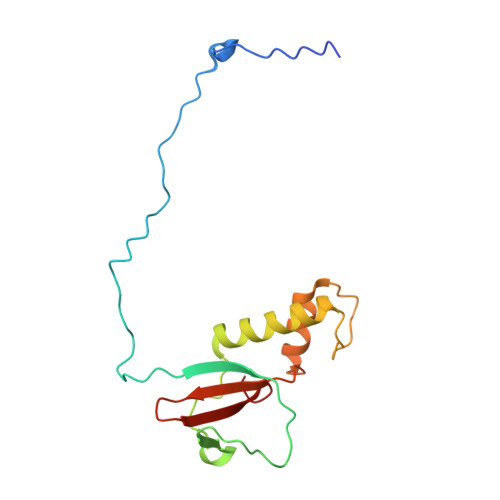
21KO | pdb_000021ko

Solution structure of fission yeast Rpb6, common subunit of RNA polymerases I, II, and III

  • Classification: NUCLEAR PROTEIN
  • Organism(s): Schizosaccharomyces pombe 972h-
  • Expression System: Escherichia coli
  • Mutation(s): No 

  • Deposited: 2025-12-19 Released: 2026-08-12 
  • Deposition Author(s): Okuda, M., Nishimura, Y.
  • Funding Organization(s): Ministry of Education, Culture, Sports, Science and Technology (Japan), Japan Agency for Medical Research and Development (AMED), Japan Society for the Promotion of Science (JSPS)

Experimental Data Snapshot

  • Method: SOLUTION NMR
  • Conformers Calculated: 100 
  • Conformers Submitted: 20 
  • Selection Criteria: structures with the lowest energy 

wwPDB Validation 3D Report Full Report

Validation slider image for 21KO

This is version 1.1 of the entry. See complete history

Literature

Evolutionarily Conserved Interactions of RNA Polymerases with TFIIH via a Common Acidic Tail of the RPB6 Subunit.

Okuda, M.Yoshimura, Y.Hayashi, A.Nakayama, J.I.Nishimura, Y.

(2026) J Mol Biol 438: 169965-169965

  • DOI: https://doi.org/10.1016/j.jmb.2026.169965
  • Primary Citation Related Structures: 
    21JG, 21KO

  • PubMed Abstract: 

    In eukaryotes, the three RNA polymerases (RNAPs) share a flexible acidic N-terminal tail (NTT) derived from the common subunit RPB6. In human, NTT interacts with the PH domain (PH-D) of the p62 subunit in the general transcription/repair factor TFIIH. Although the respective binding sites are highly conserved in vertebrates, they are poorly conserved in fungi. Here, using NMR spectroscopy, we reveal that in the fission yeast Schizosaccharomyces pombe, NTT interacts with PH-D via a distinct binding mode. In human, NTT adopts a defined structure on the basic surface of PH-D, sequentially forming an acidic string, inserting phenylalanine into a pocket, contributing an acidic β-strand to a β-sheet with PH-D, and inserting valine into another pocket. In S. pombe, by contrast, NTT adopts the acidic string and inserts phenylalanine but neither contributes a β-strand nor inserts valine, suggesting that the former features constitute the core binding elements, whereas the latter provide additional interaction modules. Docking models of S. pombe RNAPs and TFIIH support NTT as a suitable binding platform for TFIIH and suggest that it has a role in transcription elongation and DNA repair. Moreover, substitutions of acidic residues within the NTT affect the stability of Rpb6 in S. pombe cells, and mutant cells expressing Rpb6 varinats with selected substitutions exhibit increased sensitivity to methyl methanesulfonate (MMS), which induces DNA-damage repaired by nucleotide excision. Collectively, our findings provide structural insight into the conserved function of RPB6 NTT in RNAP-mediated processes.


  • Organizational Affiliation
    • Graduate School of Medical Life Science, Yokohama City University, 1-7-29 Suehiro-cho, Tsurumi-ku, Yokohama 230-0045, Japan.

Macromolecule Content 

  • Total Structure Weight: 16.16 kDa 
  • Atom Count: 1,099 
  • Modeled Residue Count: 142 
  • Deposited Residue Count: 146 
  • Unique protein chains: 1

Macromolecules

Find similar proteins by:|  3D Structure
Entity ID: 1
MoleculeChains  Sequence LengthOrganismDetailsImage
DNA-directed RNA polymerases I, II, and III subunit RPABC2146Schizosaccharomyces pombe 972h-Mutation(s): 0 
Gene Names: rpb6rpo15SPCC1020.04c
UniProt
Find proteins for P36595 (Schizosaccharomyces pombe (strain 972 / ATCC 24843))
Explore P36595 
Go to UniProtKB:  P36595
Entity Groups
Sequence Clusters30% Identity50% Identity70% Identity90% Identity95% Identity100% Identity
UniProt GroupP36595
Sequence Annotations
Expand
Reference Sequence

Experimental Data & Validation

Experimental Data

  • Method: SOLUTION NMR
  • Conformers Calculated: 100 
  • Conformers Submitted: 20 
  • Selection Criteria: structures with the lowest energy 

Structure Validation

View Full Validation Report


Entry History 

& Funding Information

Deposition Data


Funding OrganizationLocationGrant Number
Ministry of Education, Culture, Sports, Science and Technology (Japan)JapanJPMXS0450100021
Japan Agency for Medical Research and Development (AMED)JapanJP21am0101073
Japan Agency for Medical Research and Development (AMED)JapanJP22ama121001
Japan Society for the Promotion of Science (JSPS)JapanJP23H02426
Japan Society for the Promotion of Science (JSPS)JapanJP21K06035

Revision History  (Full details and data files)

  • Version 1.0: 2026-08-12
    Type: Initial release
  • Version 1.1: 2026-08-26
    Changes: Database references