Download Mendeley
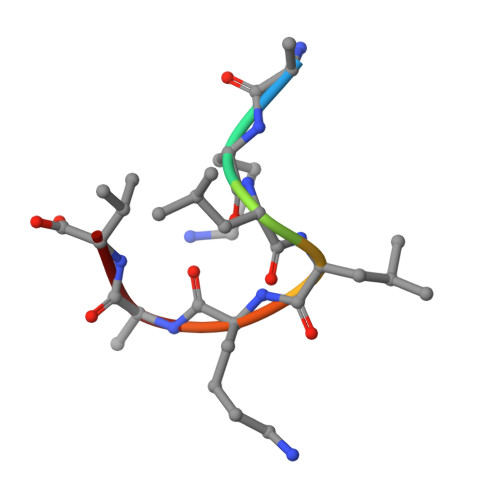
Peptides adopt stable omega-loop structures in concentrated sulfuric acid.
Zhang, J.Y., Dregni, A.J., Petkowski, J.J., Seager, S., Hong, M.(2026) Proc Natl Acad Sci U S A 123: e2618039123-e2618039123
- PubMed: 42696554 Search on PubMed
- DOI: https://doi.org/10.1073/pnas.2618039123
- Primary Citation Related Structures:
12UF, 12UG, 12UI - PubMed Abstract:
The search for life beyond Earth has focused on planets and moons with liquid water, reflecting the assumption that complex biomolecules require aqueous environments to remain stable and functional. Such a view excludes a wide class of planetary settings, including the concentrated sulfuric acid clouds of Venus, where extreme acidity and minimal water are thought to preclude molecular structure despite suitable temperatures. A growing body of evidence shows that a wide range of organic molecules can remain stable in concentrated sulfuric acid, including nucleic acid bases, amino acids, lipid micelles and vesicles, and peptide nucleic acid (PNA), but such stability does not address whether macromolecules can retain folded structures required for function. Using NMR spectroscopy, here we show that three peptides adopt stable, well-defined folded structures in concentrated (98% w/w) sulfuric acid, an extreme solvent environment that has been long assumed to be incompatible with biomolecules. The peptides form compact Ω-loop conformations stabilized by solvent-mediated interactions and intramolecular hydrogen bonding. This finding strongly counters conventional thinking where sulfuric acid would destroy peptide bonds via acid-catalyzed hydrolysis. Here, the near absence of water in 98% (w/w) sulfuric acid means hydrolysis does not occur. The result identifies a regime in which macromolecular structure persists under conditions long considered incompatible with life. The finding expands the range of planetary environments that may support complex chemistry and motivates renewed consideration of chemically diverse exoplanets in the search for signs of life beyond Earth.
- Department of Chemistry, Massachusetts Institute of Technology, Cambridge, MA 02139.
Organizational Affiliation: